After entertaining audiences across the UK with his standup tour, Jersey-born comedian Christian Jegard is bringing his hour show ‘Mr Showbusiness’ to the Jersey Arts Centre ahead of his Edinburgh debut in August. As seen on TV in the BBC New Comedy Awards and as heard on Radio 4, you might also know him from his award-winning mockumentary web series produced for Arthouse Jersey about the Jersey Music Scene.
In anticipation of his revelry of razzmatazz, we caught up with Christian to find out what we can expect.
Hi Christian. So how did it all begin?
Well apparently a nebula collapsed a few billion years ago- this caused molten rocky clumps to merge- which cooled, allowing a crust and oceans to form.
No, how did your comedy career begin?
Oh, I tried out some jokes onstage and just kept doing it. Then a crust and bio-atmosphere formed. I got told all about Nebulas by that guy from D:Ream.
Brian Cox?
No, the singer. Peter Cunnah.
Who or what is Mr Showbusiness?
It’s the title of my comedy hour special, which I’m bringing to the Jersey Arts Centre on Friday 17th April. I read it in a Chortle review of my act, and it seemed to sum everything up. I do it all- comedy, songs, magic, key-cutting, ventriloquism, tap-dancing… the lot. Actually I’ve dropped the key-cutting from the act. It was a pain to bring on the cutter every night, and people were more applauding the machine than me.
Some say your onstage persona is a character.
Some say Gallery Magazine’s mum is a heavy drinker. I can’t control the flapping of loose lips.
You now live in Brighton, but you grew up in Jersey. Does Jersey play a role in your comedy?
Absolutely. Jersey has always been in my DNA as an entertainer, my sense of showmanship was informed by what i absorbed as a child- The Living Legend, The Fantastic Tropical Gardens, Cyril LeMarquand House. I think it was a mistake to demolish that, if only for the fact there’s not enough buildings called ‘Cyril’.
I remember sneaking into Fort Regent as a kid to watch Dylan Moran. He started doing this rather unfunny bit where he sang a latin-flavoured song, kept looking at his watch and talking about how it was ‘Chico Time’. I thought to myself, ‘I can be funnier than this.’ I later realised I’d snuck in to Chico – but the wheels were already in motion.
What can audiences expect to take away from the show?
Don’t take anything away, behave yourselves. They were whipping away the fixtures in Cardiff, that’s not on.
How has the show developed as you’ve performed it around the UK?
It hasn’t. If anything I’d say it started out fully-formed and has regressed slightly. But it’s still funnier that most shows, I’ll tell you that for nothing. You want guffaws, I gots the goods.
What venues have stuck in your mind?
Oh, Brighton Komedia, for sure. Of all the venues i’ve performed in, that was easily the most recent. But I can’t wait to do Jersey Arts Centre. Growing up I always wanted to perform there in some capacity. This is totally true – I graced the stage there just once as a kid with my primary school and we did a production of Alice in Wonderland.
I had no lines, and was given the insultingly small role of 2nd Ladybird (there were four ladybirds in total). All I had to do was run across the stage and look surprised. Well, while the other three ladybirds were phoning their performances in, I was Philip Seymour Hoffmaning all up in that piece. You’ve never seen a ladybird so surprised. I’m pretty sure audiences walked away thinking ‘Wow, that play about a surprised Ladybird encountering a girls tea party really spoke to me.’
What songs do you sing?
All sorts. I’ve got a soul banger called ‘bedsit party’ about having a great but very small party in my bedsit- it’s about having the best time you can in an extremely limited space. I’m also working on a punchy little ragtime swing ditty about the suffocation of trade routes during the Spanish Civil War.
And I’ve also got a jazzy little number called ‘Lost my Girl’ with a live video link of backing singers behind me.
What’s that song about?
Its about four minutes.
So finally, what would you like to say to the people of Jersey?
I’d say this is the only chance to see my show on the rock so get yourself down If you’re looking for a good laugh in the vein of stuff like Vic & Bob, Les Dawson or Robert Peston, if you want to hear some rat pack style swing, if you liked being dazzled by dance routines, or if you simply just need some keys duplicated. Its a thing to do in town on Friday after work. It’s fun. Don’t deny yourself fun, you’re gorgeous and you deserve better.
‘Christian Jegard: Mr Showbusiness’ is on at Jersey Arts Centre on Friday 17th April. For tickets, visit artscentre.je
At Jersey College for Girls, the performing arts are not just subjects on a timetable, they are a vital part of how we empower our students to discover their voice, build confidence, and achieve academic excellence. Starting from Year 7, our Music and Drama curriculum help students develop their creativity, resilience, and communication skills, laying the stage for success in every aspect of their life.
A Curriculum That Inspires and Challenges
Performing arts education nurtures a combination of cognitive, social, and emotional skills that are not only transferable to every academic subject and valued highly in further education and the workplace, but also essential for young women as they develop into leaders. It cultivates communication skills, discipline, attention to detail and problem-solving as well as their imagination and adaptability. It also helps students develop the ability to think from different perspectives and to work collaboratively, as they learn how to listen, support one another, and share responsibility through group performances to ensemble work. Just as importantly, performing arts bring much needed levity amid academic subjects – whilst still challenging our students in many fronts, they bring amusement into their day, allowing them to explore new things in a relaxed way.
Preparing Students for Success – in College and beyond
Research consistently shows that students who engage in the performing arts often display improved academic outcomes. Musical training strengthens memory, auditory processing, and mathematical reasoning, while Drama enhances reading comprehension, empathy, and critical thinking. By integrating the arts into the school experience, we support our students in learning more holistically, improving concentration, perseverance, and the ability to work under pressure. As they engage deeply in the performing arts, our students gain not only stronger academic foundations but also the courage to lead, the confidence to be heard, and the imagination to shape their future with clarity and purpose.
A Stage for Everyone
Our Music and Drama pathways are designed to be inclusive, ambitious, and enriching. Students explore a wide range of genres, cultures, and performance styles, ensuring that every girl finds something that resonates with her interests and identity. Opportunities for showcases, productions, solo work, and collaborative projects enable students to grow progressively in skill and confidence. Throughout the year, students can take part in a variety of House competitions that enable them to showcase their skills and develop new ones. These range from House Music, where they can shine as solo instrumentalists and vocalists, as well as in bands and ensembles, to House Drama, where they take centre stage in plays chosen by their House Captains and our annual dance and haute couture competition, Top of the Pops and House Fashion. Our JCG Youth Theatre has built a reputation for high calibre productions that enchant the local audience.
Likewise, our musicians have the opportunity to take part in public performances such as our Summer Concert, our Snowdome and our series of recitals at the Georgian House, recently launched in partnership with the National Trust of Jersey.
These performing opportunities give our students the chance to hone their performance skills in a professional manner, whilst also enabling other students to gain expertise in technical production skills such as stage management, lighting, and sound. As Mia Procter, JCG’s Drama Captain, said: “Performing is an amazing form of self expression: it not only brings me immense happiness, but it also brings an opportunity to share that joy with others. I think this is what makes performing so rewarding, and why it gives people such a great sense of purpose.”
Creating Lifelong Passion and Purpose
For many of our students, performing arts become more than a subject—they become a passion. Seeing them growing into their enjoyment of performing never ceases to amaze and inspire us. Whether they continue into further study, pursue careers in creative industries, or simply carry a love of music and performance with them throughout life, our curriculum lays the foundation for personal fulfilment and creative expression.
“At Jersey College for Girls, we believe that the performing arts have a unique power to shape confident, compassionate and courageous young women,” our Principal, Carl Howarth, said. “When our students step onto the stage, they are not simply performing — they are discovering their voice, embracing challenge and learning the strength that comes from collaboration and creativity. “I am immensely proud of the passion, dedication and joy our students bring to every rehearsal, every performance and every creative endeavour. Their work reminds us that the arts don’t just enrich school life — they enrich who we become. As we celebrate their achievements, we also celebrate the teachers, families and wider community across Jersey who champion the arts and recognise their lasting value. Together, we are nurturing young people who will go on to lead, inspire and contribute with confidence, imagination and heart.”
To find out more about our performing arts offering and wider curriculum, visit jcg.je
This is my first time writing this, which probably explains why I’ve left it until the final hour. I’m in the passenger seat of Gallery’s delivery van, typing in the dark after two months of procrastination. I briefly considered flying under the radar and borrowing Ben’s format, starting with an obscure pop culture reference and baking in some mild irreverence where possible, hoping it passed unnoticed. But it felt like a strange way to approach an issue themed around “expression”.
And why hide? There’s a lot to be proud of in this issue. It’s a common complaint that not much interesting happens in Jersey, and when I moved back, I was under the same impression. But working in a job like this has a way of disproving that fairly quickly. You end up meeting people doing all sorts of strange and interesting things, taking portraits in the Amazon, running marathon after marathon in a giant shoe, or, in one case, a lingerie model planning to introduce us to her giant African snail, Gazza. We didn’t quite make it to that one. He went into sudden hibernation ahead of the shoot, but we’re holding out hope for a summer appearance.
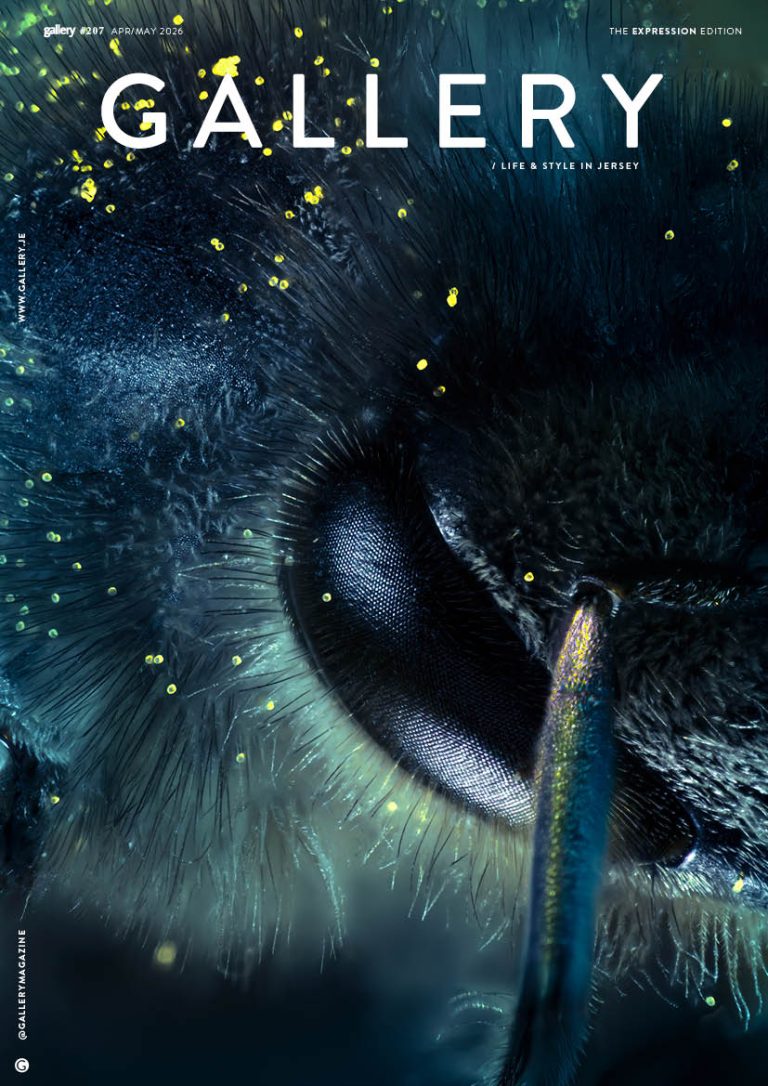
This issue brings some of that range to the surface. There’s a six-page feature on local photographer Glen Perotte’s recent project capturing microphotography of bees for Jersey Honey, which also happens to be our cover. It makes visible each hexagonal facet of the eye and each grain of pollen (page 18). Alongside that, there’s an entire supplement dedicated to the performing arts in Jersey, along with an ode to the upcoming Jersey Blues Festival in the Royal Square, which, remarkably, is free to attend (page 44). On the topic of using voices for change, we hear from Issa Amro, named in TIME100 Next, on how making a difference can be folded into everyday life (page 24). There are also fresh thoughts and recipes from Korea from our in-house food fanatic Flo (page 114).
On the digital side of “expression”, we’ve got words from our tech writer Toby on developments in audio interpretation by machines. Most of us are familiar with shouting at Alexa as it misunderstands something simple, with conviction, or Siri suggesting you try again later. ‘Killing the Keyboard’ was Toby’s attempt to take that one step further, building an app from scratch using nothing but dictation on a ski lift. You can find that on page 120.
Realising how far AI has come in just the last few months can, at times, feel slightly unsettling. It doesn’t shock me to hear someone mention they have a whole “team” of AI agents working together in a strange internal structure made up entirely of code. Quite what that means for employment going forward is still up in the air.
On that note, and thinking about work more generally, I spoke to Sonia from Rayner’s Launderette to understand what it is that makes us enjoy what we do (page 56). Somewhere between the dry cleaning and the day-to-day running of the place, it became clear that managing a launderette and editing a magazine have more in common than you might expect. When Jules, Ben’s new AI agent, becomes sentient and starts running the place, you’ll know where to find me.
The word fresh draws a few things to mind: new, not stale, original. That’s precisely the thing we are craving most in the art and music world, particularly here on Island. There’s nothing more thrilling than discovering the undiscovered, hearing the unknown, and supporting the up and coming. Lucky for us the island is ripe with freshness, it’s just about unearthing the talent.
So meet Will Howarth, Jersey’s very own local treasure. “Born and bred in Jersey”, and at 20 years Will Howarth is breaking into the music world, funding and fuelling his passion working in the everflourishing finance sector. Only just out of his teen years, Will seems to brace everything with subtle self-assurance, eagerness to learn, and blissful optimism. As a singer-songwriter, Will Howarth is locally appreciated for his emotionally evocative acoustic songwriting, blending heartfelt lyrics with stripped-back arrangements. With his songwriting placing him more akin to a storyteller, as he weaves fictional and inspired narratives with a seemingly natural ease.
Now in his final year of his degree apprenticeship with Lloyds Bank, whilst Will is keen to retain his position, he’s amping up to shift his focal point in a more balanced way to accommodate immersing himself in his music career; as he exclaims “it is the biggest passion of my life”.
Coming from a particularly musically minded family, Will has been immersed in music from an early age– whether that be playing piano from the age of eight or becoming enchanted by old CDs on long car rides. Having called it quits with the piano at the age of fifteen, Will wisely made the choice to pick up the guitar as his next creative outlet. Beginning his guitar tutoring at Chordz Music School, Will continued his lessons with his tutor Ben, studying at both The School of Popular Music and now the Red House Yamaha Music School. Coyly Will discusses his introduction to singing: “I used to be a town church chorister back in the day, when I was nine or something like that”. Yet, he admits “that didn’t really spark” his love for singing, it was in fact in his secondary school years that Will truly acknowledged his intrigue into vocal work. “I always sang at home, but never to an audience…it’s just too embarrassing when you’re a young person”. Lucky for us, at the age of eighteen, Will took the plunge and finally sang in front of an audience for the first time: “and from then on I was just hooked with singing in front of people”.
Beneath a youthful freshness, Will carries an older head on his shoulders, making for an eclectic and interesting range of musical influences. Will draws inspiration from the classics on his day-to-day playlists, citing artists such as the Bee Gees and Marvin Gaye alongside more contemporary voices like Olivia Dean and Tom Misch.
For Will, the creative process takes on a life of its own; while he may begin by listening to a track and drawing inspiration from an artist, the end result often evolves into something entirely unrecognisable. “When I’m writing a song, I’ll always go into it with: okay, I want it to sound like this song, and then I’ll just noodle around on the guitar until I find a nice chord pattern, and then a melody… and then it will sound so opposite to what I expected it to sound like, but it sounds in my head like what I wanted… so it works”.
Songwriting unintentionally and abruptly became a part of Will’s life back in 2023, as he recalls the tale of his first songwriting experience. While staying in St Ouen’s with his family at the Barge Aground, Will recalls how his family were all suffering with Covid, therefore he bought his guitar along in an effort to occupy his time, or as he puts it: “I can’t be stuck in this cabin, bored out of mind with covid, so I bought my guitar along with the intent of just playing it… not writing a song”. Alas, that’s not what panned out, “it’s so strange. One night I was asleep, had this crazy nightmare, and then woke up with all these chords in my head… so I picked up my guitar and then kind of just worked around the chords”. These phantom nightmare chords were not immediately transparent to Will, he couldn’t envision the finger positioning on the fret board, instead he conceived what they were through playing around with different progressions and ultimately matching the sound to what he relayed in his mind. As for lyrics, Will credits them as family effort, “we just all sat around the dinner table one night… just kind of firing off some really terrible lyrics at each other. And then some things would be really good”. For Will, this three day stay at the Barge Aground in St Ouen’s was a groundbreaking catalyst for his songwriting journey. The song in question is titled ‘Wasted Bit of Luxury’, and whilst it’s not out on streaming platforms as of yet, you can catch a snippet of it on Will’s socials.
If you missed Will’s most recent Art House gig at The Barracks, in which he treated his audience to tasty renditions of his original tracks, you can be sure to catch Will at some of his favourite local venues in 2026; with honourable mentions of his local pub, The Royal, and The Sundown. Although Will’s time is occupied at this present time with being in the final year of his degree apprenticeship, he gives the impression that if gigs come his way, he’ll be picking them up at the drop of a hat. Currently on Will’s creative schedule for the year are several weddings, including the honour of performing at his own guitar teacher’s—an honour that speaks volumes about his talent. From his perspective, while there is an unmistakable pleasantry to earning money for playing live gigs, he humbly expresses “I would do it for free. And I know it sounds stupid and ridiculous, and cheap, but it’s true”; exemplifying Will’s immense passion for performance. As for
the future, whilst he refers to Jersey as a “paradise on Earth”, he counteracts himself by saying that it is “a tiny tiny island”: after all it is only appropriate that those with creative minds spread their wings if only to spur more creative flow and inspiration. Will reflects on the possibility of travelling—perhaps hiking through Sweden and Iceland—with the idea of one day moving to the UK. Still, his connection to home remains clear, as he admits: “I want to come back to Jersey eventually”.
In a scene that craves youthful, refreshing originality, Will Howarth stands as an ever-evolving personification of creative freshness. With a future rich in musical exploration and rooted in instinctive storytelling, he marks himself as one of Jersey’s most compelling emerging voices—an artist to be discovered now, and followed closely in the years to come.
Alexandra Cohen is quietly redefining what family law can feel like. After years of working within traditional legal structures, she made the bold decision to step out on her own, launching a practice built on clarity, compassion and balance. For Alexandra, family law is not about rigid processes or intimidating jargon, but about guiding people through some of life’s most challenging moments with empathy, honesty and strength.
By creating a firm rooted in values and realism, she has shaped a way of working that puts clients first, helping them feel supported, understood and empowered to move forward with confidence. Just as importantly, starting her own practice has allowed Alexandra to build a career that works alongside real life, not at the expense of it. We sat down with Alexandra to talk about the leap into entrepreneurship, practising law with heart, and why a more human approach matters now more than ever.
Family law can be incredibly complex and emotionally charged. How do you balance compassion for your clients with the strategic thinking needed to achieve the best outcomes?
Compassion and strategy aren’t opposites – they work best together. Taking the time to truly understand a client’s situation, priorities and pressures allows me to give advice that is both empathetic and effective. When clients feel heard and grounded, they make better decisions. That clarity is what enables strong strategy and better long-term outcomes.
How do you ensure your clients feel heard, protected, and supported during some of the most stressful times in their lives?
It starts with listening – properly. I make sure clients understand that this is their process, not just a legal one. Going through a family breakdown involves decisions for the rest of a client’s life, and the client needs to feel as though it is their process, rather than just being another “case”.
Clear communication, realistic advice and transparency are key. I also focus on removing unnecessary conflict and unnecessary noise wherever possible, so clients feel protected not just legally, but emotionally too.
Outside the courtroom, what helps you recharge or stay inspired in such a demanding career?
Spending time with family, staying active, and creating structure outside work all help me reset. I also find inspiration in building the business itself, shaping something that reflects how I believe law should be practised. Having interests and routines outside of work keeps me grounded and brings perspective back into the day-to-day.
I also spend a lot of time house training (or trying to) and walking my puppy, Mabel. Having Mabel to look after forces me to step away from the intensity of work when I need to. Although, she has become a very popular office dog!
What advice would you give to other young women considering starting their own business or taking leadership roles in law?
Trust your instincts and don’t wait for permission. You don’t need to fit a traditional mould to be credible or successful. Build something that aligns with your values, back yourself, and remember that confidence grows through action – not perfection. It is all about taking risks when you feel ready to.
Many people only think about family law when things go wrong. How do you encourage clients to take a more proactive approach to planning and protecting their family and relationships?
I focus on education and normalising those conversations. Planning ahead isn’t pessimistic – it’s realistic and practical. Family breakdown is part of our society and day to day life, and it can happen to anyone (expected or out of the blue).
I always think it is better to have a proper understanding of the financial arrangements, your future intentions and your legal options. Proactive advice gives people clarity and control, rather than leaving them vulnerable in a crisis and desperate for a quick resolution.
Your style is described as approachable and down-to-earth, how do you make complex legal issues feel clear, relatable, and human for your clients?
By stripping things back. I avoid unnecessary jargon and explain the law in plain language, using real-world examples (where helpful). Clients don’t want to feel spoken down to or overwhelmed, they want to understand what’s happening and why. When the law is explained clearly and it feels accessible, it becomes empowering rather than intimidating.
Independence, Purpose and Balance
Kristie Potts is a Director at Appleby Global Services Jersey and the Chief Strategy Officer for Appleby (Jersey) LLP. She also sits on the boards of Family Nursing and Home Care (FNHC) and Jersey Sport, both charities that Appleby colleagues have chosen to support through fundraising and volunteering.
Your career spans senior leadership and significant board responsibility. What has been the driving force behind the path you’ve chosen?
My driving force has always been about building a career that fulfils me and fits the life I want to share with my family. I’ve chosen a career path that works for us. My younger self made deliberate, practical, simple and stable choices. I became an accountant because I knew it would always provide work. I’m focused and fairly risk-averse. I wanted financial security, a home, independence, and to be able to afford that life myself rather than relying on anyone else to create those opportunities. As I grew older, relationships changed, I started a family and new opportunities evolved. I took each role as far as it could naturally go and then stayed open to change. That’s how I moved from accounting into treasury, then project management, compliance, and ultimately into what I do now.
What drives me is independence, purpose and balance. The ability to build a meaningful career while creating the life I want for myself and my family is what makes Appleby the perfect fit. I add value for clients, support our team and continue to develop professionally, while enjoying flexibility alongside new challenges that make me proud every day.
What skills translate most powerfully between the boardroom and the charity sector?
I have young children and the charities I support are ones that have entered my life through my family. I’ve seen first-hand the impact these organisations have on islanders and want to help them continue that work while raising awareness across Jersey. I don’t claim expertise in healthcare or sport delivery, but I bring strong practical skills and a deep understanding of how organisations operate. My background includes compliance and risk, which allows me to bring governance and structure into environments where that expertise is often limited. I treat charities as I do businesses, with clarity, accountability and sustainability. I offer a business lens, and in return, those working in the sector patiently teach me what I don’t know.
How do you use your position to open doors for others, particularly women?
I’ve been fortunate to work with people in influential roles and I’m able to make introductions where appropriate. Leadership, to me, is about creating access, strengthening organisations and quietly making space for others, especially women, to succeed. I’m conscious that being female has played a role in my opportunities, but rather than feeling disadvantaged, I’ve often experienced the opposite. Most of my team is female, and I hope I show everyone, not just women, that they can aim for whatever they want if they’re prepared to work for it.
Women in senior roles are often expected to do it all. How do you define success, and what legacy do you hope to leave?
My greatest legacy will be my children. They define my success. My boys understand what it means to work, to study and to sacrifice, whether that’s time or giving up football with friends to do homework. Everyone in my world understands that you have to work hard for what you earn, and that you really can do anything if you set your mind to it. There should be no ceiling on you, whether because you’re female, male, or not the smartest person in the room. I’m where I am today not because I’m the smartest or the most connected, but because I am, and always will be, the hardest working. My definition of success is that the next generation I influence, including my children, aspire to be better than me. Maybe they take a bit of me and a lot of themselves, and ultimately become the very best they can be.
Funds, Focus and the Future
In Jersey’s thriving funds industry, excellence is often defined by technical capability, regulatory precision, and operational discipline. Yet at HIGHVERN, now operating across a broader international footprint following its combination with Permian, excellence is equally about people: how they collaborate, lead, grow, and support clients with integrity.
We sat down with three of Highvern’s leading women in the funds business – Julie Gallon, Gail Atamosa, and Emma Syvret, all Directors – to explore what exceptional service looks like, how leadership evolves, and what habits keep them grounded in a fast moving, highly demanding environment. Their perspectives reveal not only the depth of expertise within the team but also the culture that underpins HIGHVERN’s approach as the business continues to expand globally.
Leadership Lessons
Across all three directors, one theme consistently emerges: leadership is shaped over time by people, experiences, and values. For Julie, confidence, resilience and persistence have been defining forces. “But staying grounded and keeping a sense of humour is just as important,” she adds.
Emma’s leadership style is rooted in her upbringing. Raised in a family of strong women – including an aunt who became editor of a major UK regional newspaper – she grew up seeing ambition modelled with integrity. “The women around me helped me define not only where I want to go, but the kind of leader I want to be.”
Her advice to aspiring leaders is simple but powerful: “Back yourself and know your worth.” With responsibility for HIGHVERN’s Fund Administration onboarding function, known internally as the Seed Team, Emma plays a key role in setting up new fund structures for longterm success. Her days span a diverse client base across venture capital, private equity and litigation finance – each with its own complexities, timelines and stakeholders.
Reflecting on her own journey, Gail credits mentorship as a defining influence – from early professors to seniors and peers who championed excellence. Alongside hard work, she highlights adaptability, relationship building and continuous learning as essential to longterm success in the industry.
Creating Balance
Leadership brings inevitable pressure – but each director manages it in her own way. For Gail, the humble “todo list” is her nonnegotiable. “It sounds simple, but it helps me step back, prioritise, and maintain balance across work and life.” Julie finds perspective in time spent with family, friends, and her new puppy. “Downtime is so important. Highvern gives me the work life balance to fully switch off, especially when I’m on holiday. That reset lets me return energised for clients.” Emma also finds balance on the water. As an avid coastal rower, she often trains at dawn. “It sets me up for the day,” she says. And when she’s not rowing? “I’m usually reading – it’s my way to switch off and escape.”
Exceptional Service
For Gail, exceptional service begins long before a client signs an engagement letter. It starts with deep understanding and a commitment to designing a thoughtful, client-centric approach. “In practice, exceptional service means investing time in planning and creating open, transparent relationships,” she explains. “This allows us to discuss challenging areas early and resolve conflicting priorities effectively.”
But even the best plan depends on the strength of the team. Training and talent development at Highvern, she notes, are not optional extras – they are central pillars of the delivery model. “Having been here for three years, I continue to be impressed by how collaborative the environment is,” Gail says. “It’s easy to consult with peers and experts across the group. The culture sets people up to deliver their best work.” This focus on talent, culture and cross-team connectivity becomes even more important as Highvern integrates with Permian, expanding capability and geographical reach.
A New Chapter: The Highvern–Permian Combination
Julie, who has led client teams in Jersey for years, sees the combination with Permian as a natural and exciting evolution. “Permian has an excellent reputation in the Nordic market, and the cultural alignment is striking,” she says. “Meeting their teams, it was immediately clear that they share our mindset and ethos.”
For her, the greatest opportunity lies in learning not just individually, but as a combined group. “Having new jurisdictions full of people whose experiences we can learn from is invaluable. We can bounce ideas off each other, innovate together, and elevate the client experience even further. I’m genuinely excited about what we can achieve.”
This expansion reinforces what clients already value about HIGHVERN: global expertise delivered with a personal, partnership driven approach.
Business is an art
Louisa Humphrey has always been drawn to beautiful things. Her creative journey began in fashion, studying at Loughborough College of Art and Design before working as a fashion designer in Leicester, where colour, form and craftsmanship shaped her early career. But it was a spontaneous seasonal job in Méribel that unexpectedly changed the course of her life, leading her to Jersey in 1991 — a place that would quietly become home, both personally and creatively.
After working in retail, Louisa discovered what she describes as her dream role: decorative artist. Hand-painting the walls of some of Jersey’s most magnificent private homes and churches, she developed a deep appreciation for surface, detail and storytelling through design. “It was here that my eye for detail really flourished,” she reflects, a foundation that would later influence everything she does at Artizen.
In 2006, Louisa and her husband Mick decided to bring their complementary skills together, founding Artizen. What started as a small, two-person operation soon grew into one of Jersey’s most respected bespoke interiors studios. Clients — and talented craftspeople — were naturally drawn to their thoughtful, collaborative way of working and their shared respect for craftsmanship.
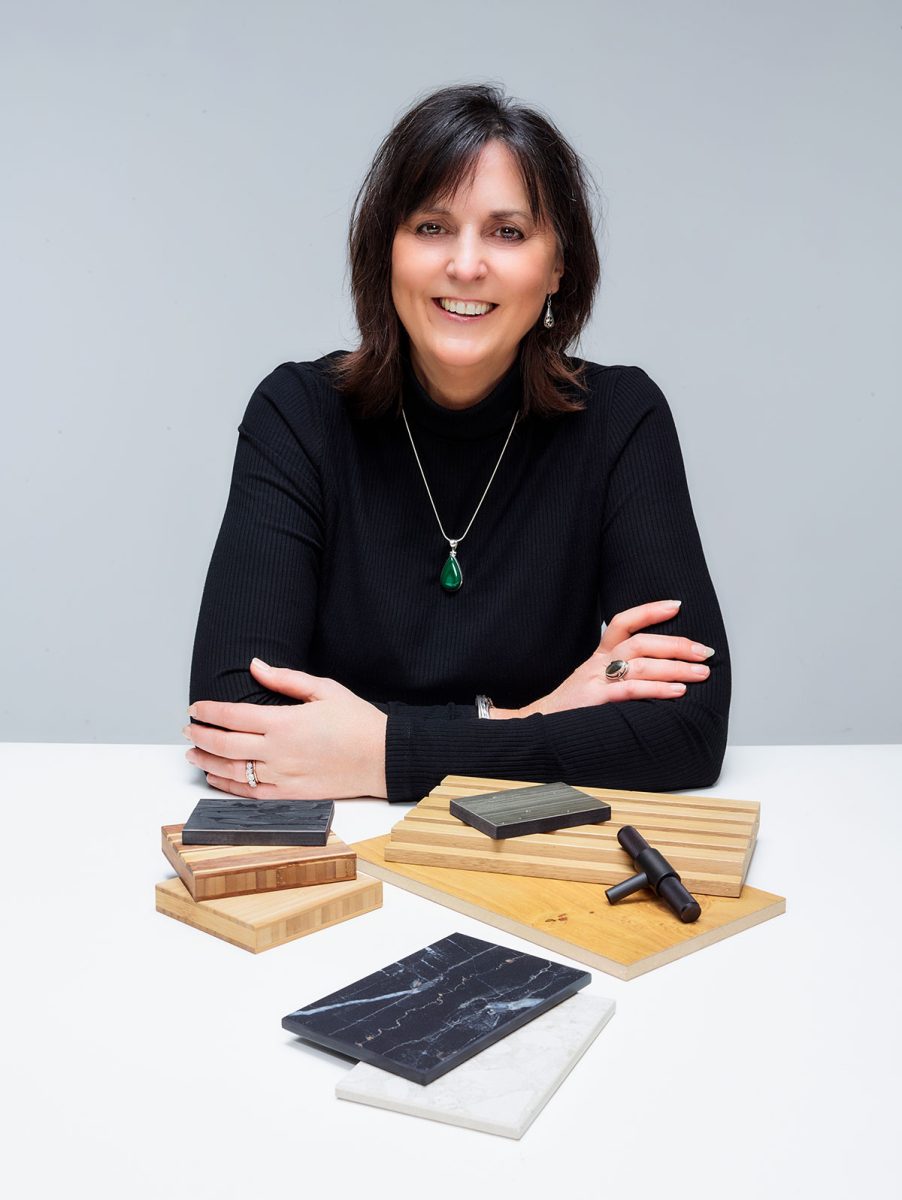
Artizen’s uniqueness lies in its deep understanding of materials and traditional techniques. “Mick’s background in antique restoration, alongside cabinet making, has given us a real appreciation of furniture construction,” Louisa explains. “We favour unique veneers, bamboo and other sustainable materials, while still using many traditional manufacturing methods.” Every piece is made locally, and collaboration with fellow Jersey artisans is central to the business. “It’s been a fascinating learning curve for me over the last 20 years,” she adds.
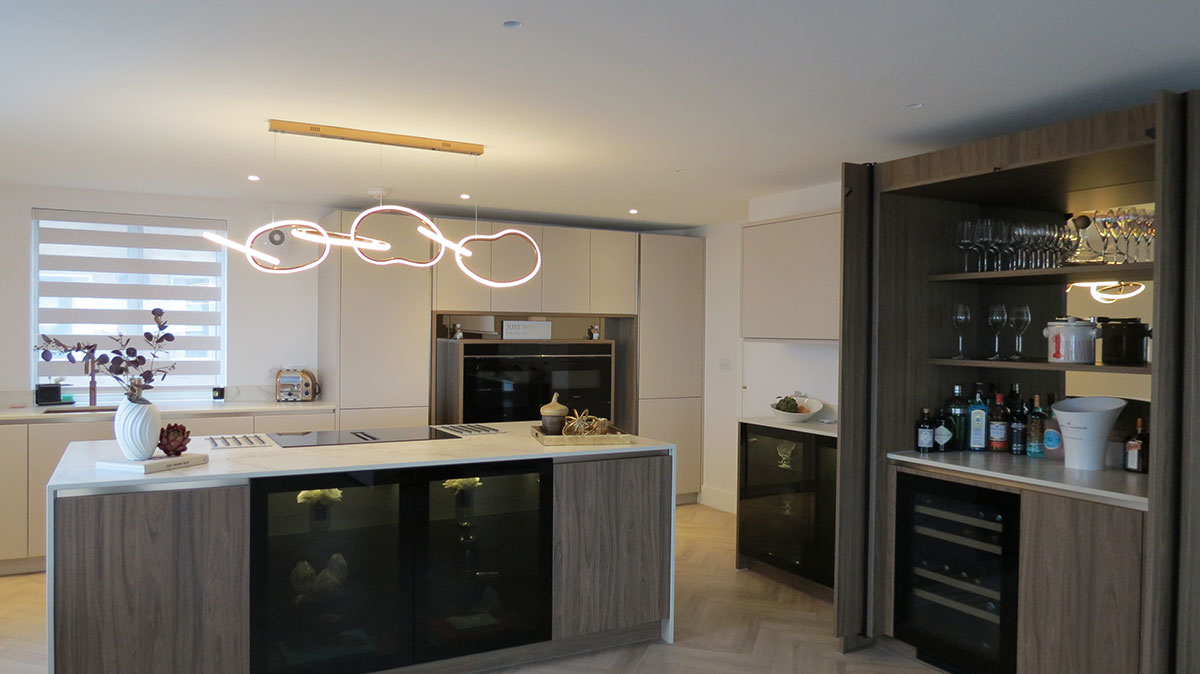
While Louisa no longer paints walls herself, her artistic background continues to shape every Artizen project. Kitchens, cabinetry and commercial spaces are all designed with a strong sense of narrative and soul. Inspiration, she says, always starts with the client. “Our designs are completely bespoke, from concept to completion, and very client-led in those initial meetings.” As keen cooks themselves, Louisa and Mick often design kitchens together. “We bounce ideas back and forth,” she says. “We take time to really understand a client’s lifestyle so we can recommend appliances and layouts that truly suit their needs. Getting to know the client is crucial to getting it just right.”
That collaborative mindset extends beyond clients to the wider team of trades and designers Artizen works with. “Reliability and top-quality workmanship are essential,” Louisa explains. “Over the years, we’ve built a trusted group of tradespeople who share the same ethos. Attention to detail and striving for perfection can never be underestimated — every element is carefully considered.”
For Louisa, the most rewarding moments often come long after a project is complete. “Walking back into a finished home and hearing glowing feedback is incredibly rewarding,” she says. “Being invited back years later — sometimes even to a party — and standing amongst our work still gives me a real buzz.” Hearing clients say, “We still absolutely love our kitchen,” she adds, “never gets old.”
Her role at Artizen is varied and ever-evolving. “I definitely wear many hats,” she laughs. “I love clicking with a client and instantly understanding their vision.” She also enjoys attending courses and events through Artizen’s dealership brands, including BORA, Gaggenau and Sub- Zero Wolf. “They really value their dealers and create inspiring experiences in places like London and Germany.” Challenges inevitably arise, particularly when working within Jersey’s characterful architecture. “The biggest challenge is ticking every box on a client’s wish list,” Louisa says, “especially with Jersey’s wonderfully quirky houses, which often demand some very clever design solutions.”
Looking back, there are several moments that stand out. “One of my proudest was attending the opening ceremony of St Thomas’ Church and seeing my decorative and gilding work admired by hundreds of people,” she says. She’s also deeply proud of Mick, “an exceptional cabinet maker whose craft was inspired by his woodwork teacher back in the late 1970s — who recently came to visit us.”
And perhaps the achievement she values most? “That, as a married couple, we still love spending 24 hours a day together.”
At its heart, Artizen is a business built on creativity, collaboration and care — where craftsmanship comes first, and every space tells a story.
Experience, expertise and a new era
Financial planning is about trust, continuity and relationships built over time, and that ethos sits at the heart of Titan Wealth’s newest offering in Jersey. Titan Wealth’s name is now a familiar one in the island and its acquisition of Advisa Wealth, a firm with deep roots and a long-established local presence, adds financial planning to its suite of wealth management services.
The Jersey team is now based in the newly named Titan House in Liberation Square, and so while there is a new name above the door, the people, expertise and commitment to clients remain firmly in place. Here, three women at the forefront of Titan Wealth’s financial planning team – Operations Manager Kasia Evans, Wealth Consultant Clair Molton and Director Jing Jing Shi – share how local heritage and the strength of the wider Titan Wealth group are shaping a new chapter for clients, without losing the personal service they value most.
Clair Molton – Wealth Consultant
Financial planning is such a people-focused role. What do you think really builds trust with clients over time?
For me, it really starts with rapport, getting to know the client and building a genuine connection. From there, trust develops naturally as the relationship grows. Some of my client relationships go back more than 20 years, and over time those relationships naturally become friendships built on trust. When people hand over money they are saving for their children’s education or a lifetime of savings, they’re not just trusting your competence – they’re trusting your character. They’re saying, “I’m vulnerable here, and I believe you’ll protect what matters most to me.” That’s an enormous responsibility, and it deserves to be taken seriously.
Titan Wealth is a new name in Jersey, but with familiar faces behind it. What feels most exciting about this next chapter for you personally?
I’ve spent 18 years with one of the businesses Titan acquired, and I’ve known several of my new colleagues for longer than that. Being able to bring those long-standing relationships together makes this next chapter particularly rewarding.
What’s one thing you know now that you wish you’d known earlier in your career?
I wish I’d appreciated just how important a pension is! In my late twenties, I once spent seven years’ worth of pension savings on a Caribbean holiday – if only I’d had a financial adviser at 30!
Jing Jing Shi – Director
What inspired you to get into finance, and realise this was the career for you?
Growing up in Shanghai and moving to the UK for university, I was fascinated by how global financial markets connected economies and influenced people’s daily lives. My Finance and Economics studies at the London School of Economics gave me the theoretical foundation, but it was working at Bank of America Merrill Lynch, which immersed me in the fast-paced world of markets, that I realised my true passion lay in helping individuals navigate their financial futures. Transitioning to private banking and then to Titan Wealth allowed me to combine my technical expertise, from my CFA qualification to systematic trading experience, with building meaningful, long-term relationships with clients. Leading our Financial Planning business now feels like the culmination of 18 years of learning: using analytical skills to deliver practical solutions that genuinely improve people’s lives.
How is technology changing financial planning and what benefits does this have for clients?
AI is transforming our industry by automating routine portfolio monitoring, providing predictive analytics on market trends and assisting to generate highly personalised recommendations based on each client’s unique circumstances and goals. I’ve seen how algorithms can process vast amounts of data to identify opportunities that humans might miss, and I’m passionate about bringing that same rigour to investment management and financial planning through AI. At Titan Wealth, we’re exploring how machine learning can enhance our investment recommendation and review processes as well as scenario planning to give clients more accurate forecasts of their financial futures. AI doesn’t replace our human advisers; instead, it amplifies our capabilities, freeing us from repetitive tasks so we can focus on what truly matters: understanding our clients’ values, providing judgment during volatile markets and building the trust that underpins every successful financial relationship.
Have you noticed any positive changes for women working in the finance industry since you started out?
When I started my career in 2006, I was one of the few women on the trading floor and it was rare to see women in senior leadership positions back then. Nearly two decades later, the representation of women in financial services C-suite positions has grown, which reflects progress even if we’re not yet at parity. Throughout my journey from Analyst to Director, I’ve witnessed firms actively investing in diversity initiatives, mentorship programmes and flexible working arrangements that recognise the realities of balancing career and family and these changes benefit everyone, not just women. At Titan Wealth, I’m proud to be part of a leadership team that values diverse perspectives and I’m committed to mentoring the next generation of women in finance.
Kasia Evans – Operations Manager
Local knowledge really matters in Jersey. How does working on-island shape the advice and relationships you build?
Working on island makes a real difference because Jersey is a close-knit community where relationships genuinely matter. Having worked in finance here since 2013, I’ve seen how personal connections, family ties and long-term plans are often deeply rooted in the island. Starting my career in an administration support role gave me a strong foundation and an appreciation for the detail behind every client relationship. As I’ve progressed into an advice role, that local understanding has stayed with me. Clients know I’m accessible, invested and part of the community myself, which helps build trust and encourages open, meaningful conversations. Ultimately, it allows advice to feel personal, relevant and aligned with real lives rather than generic solutions.
Being part of a larger group brings extra expertise behind the scenes. How does that benefit clients in simple, everyday terms? In simple terms, it means clients get the best of both worlds. They have a familiar, local point of contact who understands them personally, supported by the wider expertise of a larger group. As someone who has worked across different areas of the business and progressed through various roles, I’ve seen how valuable that behind the scenes support really is. There are specialist teams continuously reviewing markets, regulations and investment strategies, which strengthens the advice clients receive. For clients, it means reassurance; knowing their financial plans are not based on one person’s view alone, but are backed by collective experience, research and robust processes.
Outside of work, what helps you switch off and recharge?
Staying active really helps me switch off. I enjoy going to the gym and getting out for walks with my dog, which clears my head and helps me reset after a busy day. I also value spending quality time with family and friends and making the most of life on such a beautiful island. Maintaining that balance has been important throughout my career, especially as I’ve taken on more responsibility over the years. It helps me stay focused, energised and able to bring my best self to work for clients.
The Calm at the Centre of Compliance
In a world where regulation is constantly shifting and the stakes are high, Charlotte Beddoe operates at the quiet centre of it all. With more than 26 years of experience spanning compliance roles across industries and jurisdictions, she brings depth, perspective and calm authority to one of Butterfield Bank’s most senior regulatory positions.
Now Head of Compliance for the Channel Islands and UK, Charlotte’s role is anything but predictable. Her days move fluidly between boardroom conversations on emerging risk, detailed regulatory interpretation with front-line teams, and close engagement with regulators. What underpins it all is a belief that strong compliance isn’t about box-ticking, but about collaboration, clarity and good judgment. For Charlotte, the real reward lies in bringing people together across functions and jurisdictions to find balanced, practical solutions, ensuring not only that regulatory obligations are met, but that clients’ trust is earned and upheld.
You’ve spent 25 years in finance, what’s changed the most in compliance over that time, and what’s actually stayed the same?
Compliance has evolved significantly, particularly in terms of the volume and pace of regulation. Areas such as anti-money laundering, sanctions, and data protection have become far more complex. Technology now also plays a much bigger role in supporting compliance teams and it’s exciting to see how that develops. What hasn’t changed is the underlying purpose of compliance. It’s still about acting with integrity, exercising good judgement, and maintaining strong relationships with stakeholders. The focus on doing the right thing for clients and protecting Jersey’s reputation remains the same.
You’re part of Butterfield’s Jersey Management Committee. How does compliance fit into big-picture decision-making, and why is it so important to be involved early?
Being part of the committee ensures that compliance is embedded in big-picture decision-making rather than considered as an afterthought. Early involvement allows us to identify potential risks, regulatory considerations, and unintended consequences upfront, and to help shape solutions that support the bank’s strategic objectives in a practical way.
Your career has taken you across law, compliance, trust management and you even studied Islamic finance. How does having such a varied background shape the way you think and lead day to day?
It gives me a wide perspective. It helps me see things from different stakeholder perspectives both internal and external. This includes understanding our intermediaries and the challenges and client pressures they face, so I can make practical, balanced and timely decisions while keeping the bank safe.
Compliance can be perceived as complex or restrictive. How do you foster a culture where regulation is seen as an enabler of trust rather than a barrier?
Compliance can indeed be complex, and one of the most rewarding aspects of the role is finding practical, effective solutions. When compliance is seen as a partner in decision-making rather than a barrier, it becomes easier to embed a strong culture and sustainable practices across the bank. My team maintains an open-door approach, encouraging discussion and collaboration. There is no better feeling than us being able to say yes.
As a woman in a highly regulated, traditionally male-dominated sector, what lessons have you learned along the way?
Compliance teams, particularly in Jersey, have changed a lot over the years, and today women are increasingly visible in leadership roles. Our leadership team has equal representation of women and men. What I’ve learned is that building credibility comes from combining expertise with collaboration, knowing your subject, being confident in your judgement, and fostering strong relationships.
Outside of the office, what helps you switch off and reset and how do you maintain balance in such a high-responsibility role?
I’ll admit, I don’t always completely switch off, there’s always something new to learn or study, but I make sure to balance that with activities that recharge me. Going to the gym, travelling, reading and spending time with friends and family all help me reset and gain perspective.
Leading with Clarity
With a career spanning more than two decades in trust and fiduciary services, Jodie Gray has built a reputation for clarity, consistency and client-first leadership. Beginning her professional life in banking, she was quickly drawn to the intellectual challenge and variety of private client work, completing her STEP qualifications early and rising through the ranks to Associate Director at an established provider. After a brief transition into the corporate sector,
Jodie realised where her true passion lay, returning to private clients and the relationships at the heart of the work. Now a Client Director at Fairway, she brings deep experience, thoughtful decision-making and a refreshingly personal approach to an independent, owner-managed firm that puts families firmly first.
Fairway is proudly independent and owner-managed, how does that shape the way you lead and make decisions for clients?
Fairway’s independent ownership and management model was a key factor in my decision to join the firm. It allows us to act nimbly and efficiently in response to our clients’ needs, without being constrained by bureaucracy or a one-size-fits-all approach. Every client and family is different, and this structure enables us to deliver genuine, bespoke solutions. From a leadership perspective, it allows me to make clear, timely decisions that are always aligned with our clients’ best interests. When a decision needs to be made or a tailored strategy developed, we can collaborate quickly and decisively, ensuring considered outcomes.
As a director in a fiduciary business built on trust and long-term thinking, what values guide you most in your role?
Honesty and integrity have been central to my career, as they are in any relationship. I’ve always taken a direct and transparent approach with clients, believing there is little value in telling someone what they want to hear if it isn’t achievable, realistic, or in their best interests.
What leadership lessons have you learned that you wish you’d known earlier in your career?
I wish I’d known earlier to enjoy and embrace challenges rather than be daunted by them. Taking a moment to pause, listen, and genuinely consider different opinions is invaluable. We learn most from diverse perspectives and experiences. Being prepared and staying focused on the matter at hand also makes a significant difference to effective leadership.
Outside of your day to day role, what keeps you grounded and gives you perspective?
I’m a huge animal lover and share my life with four rescue dogs and four cats. Spending time outdoors, particularly walking my dogs along the beach, never fails to bring perspective and clarity after a challenging day. I’m also a cold sea swimmer and can’t advocate enough for its benefits to mental health and overall wellbeing.
What does success look like for you now, both professionally and personally?
Success, to me, is ending the day knowing I’ve done the right thing and being surrounded by good people. Professionally, seeing others develop, grow, and progress in their careers is a real measure of success and a source of great pride.
Looking ahead, what excites you most about the future of Fairway and the role women will play in shaping the next generation of fiduciary leadership?
In the three years I’ve been with Fairway, it’s been remarkable to see how far the business has come and the opportunities that have been created. We’ve expanded globally, with strong women leading our offerings in Singapore, Madeira, and Dubai – a clear testament to Fairway’s commitment to supporting and developing female leadership. What excites me most is seeing the next generation of leaders, particularly women, step into senior roles with confidence, visibility, and genuine support as the firm continues to grow.
Putting People First in a Tech-driven World
Geraldine Evans has built a career at the intersection of people, technology and possibility. As Chief Operating Officer and co-founder of Prosperity 24/7, she has spent nearly three decades helping organisations and individuals embrace change, build confidence and unlock their potential in an increasingly digital world.
Her path into learning and development wasn’t conventional. With a degree in English Literature and Italian, Geraldine began her career on an IT helpdesk for a bank, a role that quickly revealed a much bigger opportunity. She noticed that most technical problems weren’t about broken systems, but about people lacking the knowledge or confidence to use them. Instead of fixing tickets, she started fixing the root cause, developing and delivering training that empowered people to work smarter and with greater ease. That people-first mindset became the foundation of Prosperity 24/7, which Geraldine co-founded in 2011, and remains central to her work today. In an era shaped by rapid technological change and AI, her belief in communication, support and “the art of the possible” feels more relevant than ever. We met with Geraldine to talk about leadership, learning, and why putting people at the heart of technology has always been her greatest strength.
How would you describe Prosperity 24/7 in a sentence to someone who doesn’t know it?
Prosperity 24/7 is a technology consultancy business headquartered in Jersey. Our aim is to help clients integrate and use technology to solve their business problems and meet their business aspirations.
What does being a woman in business mean to you today, compared to earlier in your career?
Earlier in my career, it was certainly challenging at times to progress in my role and also meet the demands of being a mother. It meant working hard to be taken seriously in environments where women were underrepresented, especially in the technology sector. I felt a strong pressure to prove myself and to navigate spaces where there were very few women to look up to or learn from. At times, it felt like success depended on adapting to an environment that wasn’t designed with women in mind. For both my children, parental leave was only 6 weeks in duration, with very few flexible working provisions. I also did not have any family support on island.
Today, it means something entirely different to me. Being a woman in business now feels like an opportunity to shape the environment, rather than fit into it. I focus on using my position to support others and help create pathways that make it easier for the next generation of women coming through.
I also now have the confidence to lead authentically. I no longer feel I need to mirror traditional leadership styles to be effective. Instead, I focus on empathy, collaboration, continuous learning, and empowering others, qualities that I believe are essential to modern day leadership.
What do you enjoy most about your role as COO and co-founder?
What I enjoy most about my role is the ability to shape a company where people can genuinely thrive. As COO and co-founder, I’ve had the privilege of helping to build Prosperity 24/7 from the ground up, designing not only how we deliver our services, but the culture, values and environment embedded within them. Seeing colleagues grow in confidence, develop new skills, and progrss in their careers is one of the most rewarding parts of my work. I also love being at the intersection of people, strategy and innovation. Helping our clients overcome their fear of change and embrace new ways of working, particularly through AI and digital transformation, is something I find hugely energising. Prosperity was built on a belief in making a positive difference: to clients, to colleagues, and to the wider community. Being able to champion learning, support women in technology, mentor students, and help shape the future skills of the Channel Islands feels like a privilege.
Who are the women who have inspired or influenced you along the way?
Over the years I’ve been fortunate to work alongside women who have had a hugely positive influence on me. Their strength, empathy and conviction which created space for others, especially in sectors where women are underrepresented, influenced me and my approach to leadership. I am also very fortunate to be surrounded every day by our hugely talented female colleagues at Prosperity who model collaboration and innovation. They inspire me every day to be authentic, consistent, and committed to supporting others.
From a global perspective, Malala Yousafzai who has been fighting for girls’ rights to education since 11 years old is utterly inspiring for her bravery and courage. I also find Sheryl Sandberg, previous COO of Facebook and advocate for women’s empowerment in the workplace, interesting to follow.
What skill do you think is most underestimated in today’s workplace?
In my opinion the most underestimated skill today is the ability to have a curious mind and to continue to learn and adapt. With technology moving faster than ever, technical skills alone are no longer enough and what really makes someone stand out is being open to explore, be curious and adapt to change. As the Chair of the Institute of Directors Student Committee, I am privileged to work with students through the Future Leaders Scheme, and I see firsthand just how much of a difference a curious mindset can make. These students participate in a week-long shadowing experience with a director, during which they engage through questioning and observation to gain insights into the professional environment. The value of lifelong curiosity and learning is often underrated, and I feel unless we continue to learn and evolve, we are limiting our personal and professional growth.
What’s a career lesson you wish you’d learned sooner?
I wish I’d learned earlier that you don’t need to have all the answers to lead effectively. Leadership is about creating an environment for others to thrive, not being the expert in every scenario. Once I realised that empowering people, rather than trying to carry everything yourself, is a key ingredient to successful leadership, then my work became more meaningful and enjoyable.
Away from your professional roles, what helps you switch off and stay energised?
Spending time with my family is the quickest way for me to reset. I’m a mother to two teenagers and have two dogs so life is busy, but in the best possible way. I also travel back to Ireland regularly to see my family there which keeps me grounded and connected to home. And, of course, music, film and the gym, anything that gives me an excuse to switch off fully.
What moment in your career made you realise the real impact your work was having on individuals or organisations?
For me, it wasn’t one single moment, it was a pattern I started to notice very early on. Every time I delivered a training session, a presentation, or even a one-to-one conversation, there would be that lightbulb moment when something clicked for someone. You can see it instantly, the shift in confidence and the realisation that technology isn’t something to fear, or the excitement when someone understands how a new tool could genuinely make their work easier.
Those moments made me realise the true impact of what I do. Upskilling people isn’t just about teaching them a system or process, it’s about unlocking potential, removing barriers, and helping clients see what’s possible. Over the years, those lightbulb moments have scaled from individuals in a classroom to whole organisations transforming how they work. But at the heart of it, the impact is the same, which is giving people the skills and confidence to embrace change.
Looking ahead, what excites you most about the future of learning and development in the Channel Islands, and Prosperity 24/7’s role in shaping it?
We’re at the start of a generational shift in how people learn and work. AI is making knowledge more accessible than ever, and companies have a real opportunity to leap forward if they invest in building the right skills and culture around it. What excites me most is the potential to create genuinely inclusive learning environments where everyone, regardless of role or background, can benefit from technology. At Prosperity 24/7, we’re helping our clients move from “training as an event” to learning that is embedded into daily work, supported by tools like Microsoft Copilot. Our ability to combine technical expertise with our people first change approach I feel puts us in a strong position to help shape the future of skills, confidence and digital capability across the island.
Brains, grit and a bit of essential stubbornness
“My career started at a parents’ evening when I was 12,” Maria laughs. “My maths teacher made a flippant comment to my parents about how I would never be any good at maths.” What could have been a confidence knock became fuel. “Luckily for me, they passed on the message when they got home and being stubborn as a mule, I made it my life’s ambition to prove him wrong.” Fast forward through two maths A-levels, a maths degree and the offer of a fully funded Master’s scholarship, and Maria had done exactly that. Along the way, she discovered something she hadn’t expected at all. “I actually loved it. I loved the process of working through a solution and finding an answer, and I wanted to carry that clarity into my career.”
That clarity took her from analyst roles in Scotland to a chance holiday in Jersey and a dragon boat race with the founders of a hedge fund. “They were looking for a mathematician, and I’d fallen in love with this island where you could finish work and walk home along the beach. It looked like bliss. When they offered me a role, I snapped their hands off!”
Working in hedge funds and investment management, Maria found herself drawn as much to people as to numbers. “I loved acting as a translator, explaining the ‘black box’ to clients and helping them really understand what was going on.” After several roles, including seven years at ARC, a meeting with Tim Childe, CEO of Quilter Cheviot International, sealed the next chapter. “We shared the same ethos around client service, and I knew immediately it was the right fit.”
We chatted to Maria about proving people wrong, trusting your instincts, and why a little stubbornness can sometimes be your greatest strength.
Was there a defining moment when you realised finance was where you could truly lead and influence outcomes?
Growing up in a less affluent area of Leeds, money always felt like something that controlled you. When I started working in finance, I saw the opposite: the ability to help people take control of their future. That sense of responsibility, and the trust clients place in us, made me realise this was more than numbers. It was about shaping lives. That’s when I knew I could lead and make a difference.
Investment leadership often demands conviction under pressure, how have you learned to trust your judgment when the stakes are high?
For me, conviction comes from preparation and perspective. As a long-distance runner, I’ve learned the hard way that resilience isn’t built in the race, it’s built in the training. In markets, that means doing the work: research, stress-testing, and listening to diverse views. When volatility hits, I remind myself that fear is loud, but fundamentals matter. Trusting your judgment isn’t about being fearless, it’s about knowing you’ve earned the right to be confident.
Finance remains a male-dominated industry, what realities have you had to navigate that aren’t always visible from the outside?
One reality is the subtle pressure to ‘fit in’ – to adopt the language, the style, even the confidence of the room. Early in my career, as someone who grew up painfully shy and a people-pleaser, that was exhausting. Over time, I realised authenticity is a strength, not a liability. The other reality is representation: when you don’t see many people like you in leadership, you question whether you belong. That’s why visibility matters.
What role has female mentorship played in your career? – and how do you now pay that forward?
Female mentorship has been invaluable. I’ve been lucky to learn from women who lead with both strength and empathy – who showed me that you don’t have to choose between being decisive and being human. Today, I pay that forward by mentoring younger women, sharing the lessons I wish I’d known earlier: that confidence isn’t a personality trait, it’s a skill you build. And that your voice matters, even when it shakes, and mine shakes more than most!
Do you think women bring a different perspective to investment decision-making, or is that an oversimplification?
I think diversity, gender and otherwise, brings different perspectives, and that’s what matters. Women often approach risk and collaboration differently, but it’s not about stereotypes; it’s about balance. The best decisions come from diverse teams that challenge each other’s blind spots. Diversity isn’t a nice-to-have – it’s a performance driver.
In volatile markets, what separates successful investment leaders from the rest?
Discipline and empathy. Discipline to stick to fundamentals when noise is deafening, and empathy to understand the human side of volatility – clients aren’t just numbers, they’re people with fears and dreams. The leaders who combine technical skill with emotional intelligence are the ones who stand out.
What’s a commonly held belief in the investment world that you quietly disagree with?
I quietly disagree with the belief that investing is only for the wealthy. In reality, investing isn’t about having millions – it’s about building habits, understanding risk, and starting small. At Quilter Cheviot we believe that “money needs a plan” and it really does, no matter the size of the pot.
What has failure taught you that success never could?
I learnt about failure early on, when my maths teacher told me I’d never be good at maths. It was a great lesson for me as a people pleaser, it taught me that no matter how hard you try, you can’t please everyone and that’s okay. Success feels great, but it rarely changes you. Failure does – it humbles you, forces you to dig deep, and gives you a strength you didn’t know you had. It makes every win feel earned, and every setback a stepping stone rather than a wall.
How do you maintain clarity and composure when markets, and expectations, are turbulent?
Uncertainty is part of life – you can’t control everything and everyone, but you can control how you respond. In turbulent markets, I focus on fundamentals and long-term objectives rather than getting swept up in noise. Emotions drive markets, but discipline drives results. Staying calm isn’t about ignoring risk; it’s about making decisions rooted in data, not fear.
What personal habits or non-negotiables help you operate at the top of your game?
Running is my reset button. Long-distance running has taught me patience, resilience, and the power of incremental progress, all qualities that translate to leadership. I also protect thinking time: in a world of constant noise, clarity comes from space. And I never compromise on preparation – confidence under pressure is built long before the pressure arrives.
What advice would you give to ambitious women entering finance today that goes beyond the usual soundbites?
Don’t wait to feel ready – start before you do. Confidence grows through action, not perfection. And build your network early; relationships are as critical as technical skills. Finally, don’t lose yourself trying to fit in. The industry needs your perspective, not a carbon copy of what’s already there.
What’s one lesson you wish you’d learned earlier in your career?
That failure isn’t fatal – it’s feedback. As someone who grew up shy and desperate to please, I feared mistakes. But the truth is, failure teaches you more than success ever will. It humbles you and makes every win feel earned. Without weathering a storm, you will never fully appreciate the feeling of the sun on your back.
Finally, what excites you most about the future, for the industry and for the next generation of women leaders?
I’m raising two incredible daughters, now 10 and 13, and they are already far more confident than I ever was. We’re no longer raising girls to be seen and not heard – we’re raising them to be fierce, to go after what they want, and to believe they can be anything they choose. I’m incredibly excited to see what this generation brings to the industry, and especially to leadership. They have an extraordinary blend of empathy and strength, and when combined with the power of AI and their ability to harness technological advances, I believe the next generation won’t just enter finance, they will shape it. And they’ll do it on their own terms.
Where Expertise meets Impact
With a career spanning more than a decade at Saltgate, Hannah Stevely is a powerful example of what long-term investment in people can achieve. Having joined the firm 12 years ago as a Senior Administrator, Hannah’s journey has taken her through fund accounting, leadership, and strategic management, evolving alongside the business itself. Now an Associate Director within the Client Services team, she oversees around 40 people and sits at the intersection of technical excellence and human connection.
For Hannah, great leadership isn’t just about ticking boxes or meeting deadlines, it’s about being present, adding value, and empowering others to grow. Known for her thoughtful approach and calm authority, she believes exceptional client service comes from simplifying complexity, anticipating challenges, and building relationships that feel like an extension of the client’s own team. In this interview, Hannah reflects on her leadership journey, the importance of continuous learning, balancing a demanding career with motherhood, and why impact, integrity and balance define success for her today.
You’re an Associate Director within Saltgate’s Client Services team, what does a great day at work look like for you?
If I get to the end of the day and I’ve ticked off more things from my to-do list than I’ve put on, that’s a win! But generally, a great day is being in the office and supporting my team; I have oversight of around 40 people and I love being present to support them. It’s rewarding when the team come to me for guidance; I leave knowing I’ve passed on some knowledge. If I create something where I know I’ve added value, I feel it’s a job well done. It’s a balance between strategic thinking and human connection.
Fund administration can be complex. What do you think really sets exceptional client service apart in this space?
Exceptional client service, in my view, comes from conscientious staff. Technical excellence is a given, but what really sets the bar for exceptional service is the ability to simplify complexity and to foresee issues before they arise. The goal is for the client to view us as an extension of their own team.
Saltgate invests heavily in people, development and technology. How has that focus supported your own growth and leadership journey?
I’ve had the opportunity to qualify as a Chartered Accountant, and develop my leadership skills alongside my technical expertise, with genuine encouragement to think strategically. Saltgate also has a fantastic and long-standing leadership team – which has helped hugely in my own journey to leadership. We have a lot of inspirational women within our business!
What’s the best piece of career advice you’ve ever been given and do you actually follow it?
“Remember every day is a school day” – never be afraid to ask questions and humble yourself if there’s something you don’t know. I’ll always hold up my hands if I don’t know the answer.
Looking ahead, what excites you most about the future – for your career, for Saltgate, and for you personally?
I’m really excited to continue to add value to the Senior Management Team, it’s a very rewarding role and gives you fascinating insight into how the business operates. I am particularly interested to see how the industry landscape develops over the next 5 years with the increasing adoption of AI and tech, and to see how I can utilise this in my own life; both professionally and personally.
What do you get up to outside of work?
I spend most of my time with my daughters; we love to go for hot chocolate at the WaterSplash and watch Gilmore Girls together. When I’m not living my best mum life, then exercise and spending as much time outdoors are my greatest sanity savers. I took up surfing recently, and I love road cycling, running, and lifting weights.
As both a parent and a successful professional at Saltgate, how do you navigate the balance between your personal and professional responsibilities, and are there any tools or strategies that particularly support you?
The balance is never static. I’m always very intentional about planning my time and being fully present, whichever role I’m in. Saltgate are a fantastically supportive company with a lot of flexible initiatives, having an employer that genuinely understands that high performance and parenthood can coexist makes an enormous difference.
What does success look like to you right now and has that definition changed over time?
Success for me looks like impact, balance, and integrity. It’s showing up with my best self, being a role model and a good mum to my daughters, and pursuing my own passions where I can. Before parenthood I was heavily driven by career progression, now I’m a mum to two future potential little business women, it’s about striking the balance.
Strength, Clarity and Compassion
With extensive experience in family law, Clare Woodhouse has built a reputation for combining rigorous legal expertise with deep empathy. As a Managing Associate in Viberts’ Family Law team, she supports clients at moments of profound change — when emotions run high, certainty feels distant, and clear guidance matters most.
For Clare, family law is not simply about legal outcomes, but about people. It’s about listening carefully, offering calm and practical advice, and helping clients find their footing during what can be one of the most challenging periods of their lives. She speaks with honesty about the emotional complexity of the work, the responsibility that comes with guiding families through separation, and the privilege of witnessing clients emerge stronger, more confident and ready to move forward. Clare talked to us about resilience, empathy, and why fairness, dignity and long-term wellbeing must always sit at the heart of family law.
With more than twenty years in family law, what continues to motivate you in a practice area that is often emotionally complex and deeply personal?
I have always been – and remain – motivated by my clients. It is not uncommon for the client who attends our first meeting to be very different from the person who emerges at the end of their family law journey. I am continually inspired by the resilience people show and their capacity to adapt, even in the face of changes they never expected or wanted.
I have great respect for how difficult it is to confront deeply personal challenges, particularly when circumstances feel out of one’s control. Being able to support and guide clients through such a significant life transition is a genuine privilege and one that motivates me every day. One of the most rewarding aspects of my work is seeing former clients, months or years later and witnessing the strength, growth, and stability they have achieved after a very difficult period in their lives.
Your work requires both rigorous legal analysis and a high degree of empathy. How do you balance those two skills when supporting clients through some of the most difficult moments of their lives?
After more than 22 years practising in family law, I have learned that rigorous legal analysis and empathy are not competing skills – they are complementary. Clients come to us at one of the most vulnerable and emotionally overwhelming periods of their lives. The first and most important step is to truly listen and to acknowledge the impact the situation is having on them as people, not just as legal clients. Feeling heard and understood allows clients to begin to regain a sense of stability and trust in the process.
At the same time, my role is to provide clear, objective, and practical legal advice. Emotions can understandably cloud decision-making, so I focus on breaking complex legal issues into manageable steps and explaining the likely outcomes in a calm and realistic way. This helps clients move from a place of distress to one of informed decision-making.
Empathy guides how I communicate and support my clients, while logic and legal experience guide the advice I give. By combining compassion with clear analysis and a focus on practical solutions, I am able to help clients navigate their immediate challenges while keeping sight of their long-term wellbeing and, where relevant, the best interests of their children.
As an experienced lawyer, what advice would you give to young women joining the profession?
I would encourage young women entering the profession not to shy away from difficult conversations – whether with clients or with other practitioners. It is often within those challenging discussions that real progress is made. In family law particularly, what is in a client’s best interests is not always what they want to hear. You must be prepared to provide clear, practical, and sometimes unwelcome advice when emotions and hurt are clouding judgment. Clients value honesty, transparency, and guidance they can trust.
Within the profession, I also believe women have a responsibility to support and champion those coming behind them. This includes making time to listen to younger women’s career aspirations, offering guidance on best practice, and providing both constructive feedback and genuine encouragement where it is deserved.
Finally, I would say to anyone considering a career in family law that it is more than just a job – it is a vocation. It requires a careful balance of empathy and pragmatism. Family law is not about “battling it out” for the sake of conflict. A focus on fairness, practical solutions, and what is truly best for your clients – and their children – must always remain at the centre of your work.
Looking ahead, what do you see as the most important role family lawyers can play in shaping fairer outcomes for families and children?
I believe the most important role family lawyers can play is helping families find outcomes that are fair, sustainable, and focused on the wellbeing of the family as a whole, while still carefully protecting our client’s best interests. A conciliatory and solution-focused approach – rather than adversarial litigation – gives families the best opportunity to move forward and redefine themselves as a new family unit, even when living separately.
While no one emerges from separation unscathed, family lawyers can help parents navigate this transition with dignity and respect. Our role is to assist families in finding a path forward that minimises long-term harm, preserves important relationships, and supports healthy co-parenting. The hope is that, in time, parents can stand together at significant milestones – such as a child’s graduation or milestone birthday – without their child feeling caught between them. That outcome, whenever possible, should always remain at the heart of what we do.
Empowering women in business: How Santander’s Women Business Leaders’ Mentoring Programme is shaping the next generation of entrepreneurs
For women building businesses in Jersey, the Santander Women Business Leaders’ Mentoring Programme (WBL) is more than a professional development scheme – it’s a confidence boost, a support network, and for some, a turning point in their entrepreneurial journey.
Since its launch in 2019, Santander’s Women Business Leaders’ Mentoring Programme has supported nearly 1,200 female entrepreneurs across the UK and Crown Dependencies, helping them develop leadership skills at every stage of business growth.
The Programme is in partnership with Moving Ahead, a specialist award-winning mentoring and development organisation which connect mentees to experienced business owners, or leaders with corporate experience, for 1:1 sessions alongside virtual masterclasses from inspirational role models and speakers.
Kirsty Lamond, Head of Retail Banking, Santander International, said: “This is the eighth year of the Santander Women Business Leaders’ Mentoring Programme. Last year we joined forces with Maria O’Regan and our colleagues in the UK to promote the programme locally, and this year we are looking to attract 100 new mentees from across the UK, Jersey, and the Isle of Man. These include female founders, business owners, or majority shareholders, who have been trading for a minimum 18 months. The mentoring sessions take place remotely, so mentors and mentees are matched by need and experience rather than location, which tends to offer some great pairings.”
For Rosie Whooley, Founder and Director of Renova Agency an influencer marketing and management agency, these pairings were a game changer. Joining the Programme gave her access to inspiring female leaders beyond Jersey and a mentor who helped her turn ambition into action.
“My mentor, Carole, was incredibly supportive and inspiring. She was there to help guide me the entire year and, later, provided me with the encouragement and support I needed to launch my own agency. Without her, the journey to starting my business would have been much longer and nowhere near as professional. It has been great to know Carole is always there to provide advice and chat things through, no matter what the scenario.
“During the Programme I learnt how resilient I can be, and my self-belief greatly improved. My confidence, specifically with skills in pitching and networking, has improved the most, to a point now where I’m confident to go out to gain new business, something that I wasn’t before. With my mentor’s help, I am now also very active on LinkedIn and use it frequently for networking and building connections.
“Thanks to WBL I developed the belief, skills and knowledge to set up my own business, which just a year before would not have been possible. My business started very successfully, gaining three clients within the first few weeks.”
Santander also provides ‘Beyond Mentoring’ support which includes virtual sessions addressing challenges businesses face including finance, marketing, digital, and sustainability. Participants join an established peer-to-peer network, building a community to collaborate and exchange ideas, and get free access to the Santander Open Academy Platform, a global learning initiative, providing hundreds of courses on everything from AI to leadership to sustainability.
Kirsty added: “Our priority is to our customer base, but the Programme is also open to businesses willing to be a customer, subject to meeting WBL criteria. We are also inviting experienced business owners or leaders with corporate experience as mentors to apply. Male or female applicants are welcome, but they must have knowledge of small to medium size businesses.”
The Programme’s impact doesn’t stop with mentees. Many women return as mentors, creating a powerful cycle of support and shared learning. Ceri Tinley, Co-founder and Managing Director of Consensio Chalets, a luxury chalet operator in the French Alps, has experienced WBL from both sides.
“I feel that this programme is valuable for both mentees and mentors. It is very well structured, and the value received from the training throughout is exceptional. Two of my three mentees massively restructured and streamlined their businesses over the nine months; they managed to really focus on their ‘why’ and adjust their offering to be specific and aligned with their core values which allowed them to push their businesses forward.”
The WBL Programme 2026 is open for applications from Monday 2 February to 9th March. To apply see Santander X or scan the QR code for details.
An Evening That Invested in Women: Rathbones Supports a Thoughtful Gathering of Wellness, Words and Connection
On a rain-lashed January evening, when winter can feel at its heaviest, something quietly powerful unfolded behind the doors of Lockes. Forty-two women gathered, filling the space to capacity, for an Evening of Wellness & Conversation, an event that offered warmth, depth and genuine human connection at a time of year often defined by pressure and self-criticism.
Hosted by Jersey-based health coach Nicola Eastwood alongside New York Times bestselling author Sophie Cousens, the evening was generously supported by Rathbones Investment Management International, whose involvement reflected a growing recognition that true wellbeing, much like long-term financial health, is built through thoughtful, sustainable choices rather than quick fixes.
From the moment guests arrived, the atmosphere felt intentional and calm. Soft lighting, a beautifully prepared sharing table and a bespoke warming dawa created by the team at Lockes set the tone, inviting conversation rather than performance. The evening unfolded in an open, interview-style discussion, exploring themes that resonated deeply with those present: midlife, burnout, balance, resilience and the often-unspoken realities of modern life.
Importantly, this was not an event about “fixing” oneself. Instead, it reflected a broader cultural shift away from the noise of Blue Monday narratives and punishing New Year’s resolutions, towards a gentler January, one rooted in reflection, nourishment and connection. It was an approach that felt entirely aligned with Rathbones’ long-standing philosophy of taking a long-term, considered view, whether in wealth management or in life.
Leah Lovell, Investment Manager at Rathbones, captured this alignment perfectly: “The evening created a genuine sense of connection and thoughtful conversation. It was a pleasure to support an event that brought together such an engaged community of women in Jersey.”
Throughout the evening, conversation flowed easily, sometimes thoughtful, sometimes humorous, always honest. Sophie Cousens spoke warmly about the evolving meaning of wellness, noting that it extends far beyond diet and exercise. “It might be less screen time, more reading, deeper friendships or even starting something new,” she shared. “With busy lives, finding balance is something we all wrestle with.”
Guests echoed this sentiment, describing the event as “a warm, refreshing environment with amazing women”. One attendee reflected, “It wasn’t about pressure or productivity. It was about connection, conversation and taking a breath.”
As guests lingered long after the discussion ended, the sense of community was unmistakable. Thoughtfully curated goodie bags featuring a mix of national brands and local Jersey businesses reinforced the evening’s community-focused ethos. For Nicola Eastwood, whose work focuses on supporting women through midlife transitions, the response reaffirmed the power of shared space. “Midlife and burnout are very real experiences for many women,” she said. “Creating an environment that feels supportive rather than pressured can be incredibly impactful.”
In a world increasingly dominated by speed and noise, this January evening stood as a reminder of the value of slowing down and of the organisations, like Rathbones, that recognise the importance of investing not only in financial futures, but in people and community too.
Photography and Styling: Danny Evans | Model: Elysia | Location: Rayners Dry Cleaners
LEATHER JACKET BY MARC CAIN (£389), SHIRT BY MARC CAIN (£295), AND JEANS BY MARC CAIN (£195), ALL FROM RENAISSANCE.BOMBER JACKET BY MY ESSENTIAL WARDROBE (£150) FROM MANNA. BOOTS BY MARC CAIN FROM RENAISSANCE. DRESS BY ALLSAINTS (£259) FROM VOISINS. BOOTS BY MARC CAIN FROM RENAISSANCE.SHIRT BY BAUM UND PFERDGARTEN (£209) AND TROUSERS BY HAUTE L’AMITIÉ (£100), BOTH FROM MANNA. JACKET BY MARC CAIN (£359), TOP BY MARC CAIN (£99), AND TROUSERS BY MARC CAIN (£195), ALL FROM RENAISSANCE. SHOES BY KURT GEIGER (£119) FROM VOISINS.LINGERIE TOP BY HAUTE L’AMITIÉ (£90) AND CARDIGAN BY AMERICAN VINTAGE (£128)BOTH FROM MANNA.TOP BY RIXO (£129), SKIRT BY WEEKEND MAX MARA (£200), AND BOOTS BY KURT GEIGER (£329)ALL FROM VOISINS.
Having an eye for design means being able to look at a space with fresh eyes and create something that is unique to that particular environment. Sometimes walls come down, or neglected corners become the most used area of the house. Working around awkward pillars and areas most people just pass through is a refined skill honed by interior specialists, so for this transformation feature we caught up with some locals with a knack for the craft. Over the coming pages, we share ‘before-and-after’ projects that totally transformed the mood of a room. Enclosed kitchens were opened, multifunctional living spaces created, and penthouse showpieces as well as cinematic retreats were brought to life, resulting in spaces that feel purposeful, personal, and above all, homely.
Ash Interiors
BeforeAfter
For Emilia at Ash Interiors, this transformation was a personal one. Her client was family, and the room needed an entire overhaul.
The brief was for it to be a multi-use room where they could sit by the fire, watch TV, play the piano and host friends and family for meals (there is a dining table and upright piano out of shot). “It’s a large room, and with only two rooms on the ground floor of this house, it needed a lot of work,” Emilia explained. “One of the major problems with it was the lack of any heating, and a draft through the gaps in the floorboards.” Reworking the layout came first, arranging the furniture and centring the sofa and armchairs around the fireplace. “This created a little corridor behind the sofa and divided the room into different zones,” she explained. “Previously, the furniture had seemed rather lost in a large space, and the room felt under-utilised.”
Adding vibrancy was the next step. “I was desperate to change the colour on every surface of the room, which I would describe as a dirty beige,” she explained, relaying that old fashioned tights sprung to her mind when she viewed the room. “To my eye, the yellow curtains, which we had inherited with the house, clashed horribly with it…”
Knowing that the heating was one of the main problems, Emilia ordered a huge jute rug that covered almost the entire floor, and installed a slightly unusual system of electric underfloor heating that sat over the floorboards, but under a ply board, with the rug over the top. This allowed the room to be maintained at a sensible temperature, before personality could be layered in through pattern, lamps and pieces found over time.
“To me, this is a key thing about successful interiors,” she noted. “They need to evolve over time. Sometimes the ‘not quite right thing’ actually makes the room work.”
TLC Home
BeforeAfter
Working on the penthouse of one of the Horizon apartments at the Waterfront, TLC Home knew that this project needed to be special.
“The brief from JDC was to give wow factor as well as a practical way to demonstrate how to use and dress this high-end penthouse apartment,” they said. “It had some more difficult features to work with, including a wide pillar disrupting the open plan space, one side of which has double height ceilings.”
Rather than fight these features, they decided to embrace them, softening the partition pillar with a curved edge, and installing an architectural shelving unit to make it feel intentional rather than jarring, while connecting the open plan spaces.
“We kept the colours and textures smooth and focused on reflecting the light,” they noted. A mirrored TV piece, neutral velvet sofa and glass coffee table did most of the work. To balance this with richness and softness, they added walnut shelving and luxe rugs with flowing voiles. A statement piece is the gloss lacquered dining table in apple green.
Working with this space, it was integral to design around the sea view, and ensure it was a focal point in the room. “We were keen to avoid turning our back to the sea view, so instead we brought the view into the room,” they explained. “An oversized mirror, cleverly concealing the television, reflects the expansive view and light back into the space, giving the illusion of width to balance the height of this space.”
Beaumont Home Centre
or the owners of this home, they were tired of a kitchen that felt closed in, dishevelled and an impractical use of the space. The challenge was to knock down a wall dividing the two spaces, creating an open plan hub that felt both practical and stylish, and a space they enjoyed using.
“We knew we wanted warm, neutral and earthy tones included in different textures,” said the team at Beaumont Home Centre. “The previous kitchen was very enclosed and lacked space, so we wanted to create something contemporary with practical storage solutions.” They enlisted the help of Atlas Construction, who was the main contractor they worked with.
Once the internal wall was knocked down, the team got to work building up the new space. A sink was positioned under the window near the dishwasher, and a bank of tall units was installed to include an integrated fridge/freezer and larder on either side. “This created a floating effect for the combination oven, single oven and warming drawer with mirrored wall panelling,” they explained. The vented hob was positioned on the island to take full advantage of the sea views, and a feature with pocket doors allowed the wine storage and cocktail making area to be hidden when not in use. “The aim was to make it very sociable whilst cooking, looking towards the family dining and living area,” they noted. “We also added tinted black glazed units to add contrast and create a more subtle, relaxed mood through lighting.”
The aesthetic they went with was driven by the client’s preferences, who was looking for something sleek and modern. However, the team explained that they have offered more classic or farmhouse styles in the past. When creating a scheme and ensuring the dynamic remains consistent throughout a room, the team at Beaumont Home Centre pay close attention to materials and finishes that anchor the scheme, with texture playing a central role. They paired Hacker German rigid, handleless kitchen units with bronze handles, with a shiny bronze mirror and copper sink, complete with a rose copper Quooker tap. Siemens appliances, including a vented hob, and a Dunavox wine storage unit ensured the best amenities were included. The biggest challenge came with installing the Dekton Entzo worktops with waterfall edging, using a crane to reach the apartment on the 8th floor.
Landes Interiors
BeforeDuringAfter
For this full house renovation, one room had been left untouched because the owners were at a loss as to what to do with it. The property already boasted a large eat-in kitchen with an entertaining area, as well as a snug for watching television.
Although the room benefitted from south-facing, full-height windows that flooded it with light and provided garden access, the indoor-outdoor connection had already been made through the kitchen. “I wanted to create something dramatic that would set the room apart and clearly define its purpose,” explained Manon.
This purpose became a library and cinema room, but to make the desired changes, structural work had to be done before the aesthetics could follow. “The volume lacked the theatrical impact required to make the room a true destination,” she explained. “The low ceiling was removed to reveal the full height of the room, and the 1970s brick fireplace was replaced with a stove, creating a generous gap for a large television screen. As with all my projects, the layout was resolved before applying any finishes.”
The resulting mood was guided by the rest of the house. “A blank canvas can be difficult to tackle, as there are no visual cues to follow,” Manon explained. “As the rest of the property had an organic feel, I favoured natural materials to ensure cohesion. The resulting style is both classic and modern, with a timeless quality, an approach I strive for in all my projects.”
Recognising that texture and acoustics are as important as colour, Manon chose a natural oak herringbone parquet and a seagrass rug to contrast with the dark wall covering. “I love mixing wood grains and tones to replicate nature, so darker wood furniture was added as well as textured linen armchairs, to complement the scheme,” she said. The television blends seamlessly into the dark wallpaper, while the opposite wall is lined with oak shelving. “The books themselves create an excellent acoustic backdrop,” she added. The final result was a cosy space that changes character comfortably in both day and night environments. It is now used at weekends as a retreat for reading or binge-watching a box set.
“With its distinct atmosphere, the space allows the clients to feel as though they are travelling to a new destination within their own home,” Manon said.
CP Interiors
Before
When making home renovations, the garden can frequently become overlooked. It’s the ‘when I get around to it’ part of the business, but once the wallpaper has been fixed, furniture has been moved around a hundred times and you’ve finally figured out which walls to put your favourite prints on, the thought of attempting to make something of the outdoor space becomes a ‘later’ job. This is especially true of people renovating their homes in Spring, the most popular time to get interiors ready for summer parties (which, most of the time, edge into the garden).
Designing an outdoor space can be overwhelming, especially if you don’t have a specific vision for what you want to create. Even if you do, we all know too well the hubris of biting off more than you can chew, realising there is a large chasm between the ability to think creatively, and that of skilfully executing a vision. This creative gap is best bridged by professionals who’ve done it a thousand times before, and understand how details such as glass sliding doors can let you enjoy that outdoor feeling even throughout winter. Whilst you’re fixing up the inside, they can take on the outside as their labour of love.
If any of the above has resonated with you, CP Interiors is a great place to explore. They work with you on your garden from start to finish, keeping to your design plans and ensuring that you’re fully integrated in the design process (should you desire to be). For those who find themselves staring at a patch of overgrown lawn with no idea what to make of it, CP Interiors offers a visualisation package with accurate 3D images to help you understand not only what would work best in your space, but how it would look as a finished product. “Often our clients are surprised at how accurate the final install is to the original visual,” they revealed, adding that after even a short period of time, they can’t imagine what life was like before it.
For the team at CP Interiors, the most important thing to do before starting the process is to have a long conversation over a cup of tea. This is where clients can discuss and discover what they want, by communicating what they hope to achieve from the installation and how they’d like to enjoy their space. Following this conversation, the team suggests designs that feel well thought out and in keeping with the original property, avoiding that jarring feeling you can experience when walking out into a garden that feels like a bolted-on addition, out of touch with the tone of the home. They often achieve this through colours, softer edges, accessories, and by working with the best external contractors and landscapers when needed to perfect the final look. Perfect for the summer soiree, CP Interiors are adept at ensuring gardens are designed for evening use as well as daytime, with a broad array of heating and lighting options available. These range from everyday spotlights to fun and colourful mood lighting. We’re a particular fan of their external heaters, which offer the perfect space to relax or party with friends and family should an evening chill settle after sundown.
When we asked about common mistakes homeowners make with their outdoor areas before coming to CP Interiors, their response was surprising, and very much shaped by the time we find ourselves in. “AI-generated images are now so advanced, some people really struggle to tell what’s real and what’s not,” they revealed. “Lots of the image inspiration we’re being given has often been altered, creating false spaces that either, in reality, won’t work or aren’t practical. This, combined with information from inexperienced providers, can really set people off on the back foot, and this is the reason we always try to be fully transparent with our clients about what’s possible from start to finish.”
CP Interiors recognise the unique nature of every home in Jersey, and that many projects often require bespoke, custom designs. “Small spaces are particularly challenging,” they noted. “You want to make the most of extending your space, but need to be mindful that you don’t overcrowd it.” It’s one to keep in mind when deciding whether you have the skills to renovate your own garden, or if you could benefit from some professional help. It could also be useful to get advice on the thorn in the side of every property developer: regulatory approval. “Whilst planning permission isn’t required for the majority of projects, every now and again one of Jersey’s unique planning restrictions gets thrown in,” they revealed. “This alone can be a challenge in itself.” On the rare occasions when this is required, CP Interiors are there to help.
I recently binged Vince Gilligan’s Pluribus. Once I put the post-binge shame of consuming 8 hours of content in a worryingly short window behind me, I was struck by the parallels from the story to the AI armageddon that we are told to worry about.
Spoiler alert
Carol, the main character, rails against the hivemind virus that has infected humanity. She despises the collective consciousness, eventually driving the entire human race to tears and causing millions of deaths just to break free. But when the hivemind finally leaves her, the silence is deafening. Carol realises how alone she is without them. It’s the absence of them that puts into sharp focus what they’ve added to her life.
It sparked a thought – what would my working day look like if I couldn’t use AI? Would I notice it? How much more work would I have to do?
Last month, OpenAI published The State of Enterprise AI, claiming that workers are now saving between 40 and 60 minutes per day. On paper, that sounds like the world-changing shift tech CEOs have been promising for the last few years. But looking at my own schedule, I wondered: is that time actually saved, or have I just swapped ‘real work’ for an hour of prompting and editing?”
In my case, I’m a bit of an AI evangelist. Three years ago, when ChatGPT first hit the mainstream, I was so persuaded by it, that I quit my job and set up a design & web agency (now operating out of Gallery HQ).
Since then, AI has become the silent partner in nearly every business process I have. Going cold turkey is likely to be a painful detox, but I’m keen to find out the truth: without the hivemind, will I crash and burn? Will I feel liberated? Or, like Carol, will I simply feel worryingly alone?
MORNING – THE GREAT SILENCE
My rules for this experiment are simple:
No Large Language Models (LLMs)
No Image Generation
No “Smart” Coding Assistants
No AI Writing / Editing
However, in my naivety, I realised this was harder to enforce than I first thought when I came to draft my first email for the day and Gmail had already automatically drafted my response: “Hi Jim, I’ll sort that now”. A truly groundbreaking, timesaving activity to kick the day off. Viva La Revolution.
Following my email from Jim, I now tackle his problem. After 30 minutes of scrambling around in AI generated comments in the code and a frustrating search through StackOverflow, I fixed Jim’s issue. My initial pride at the fix is quickly dulled by realisation that I, (or Gemini), could have fixed the issue in minutes.
Next, coffee break, after all that heavy lifting. Is this how people used to work?
New Email from my Daughter’s nursery. Request for less milk, more nappies and more wipes next time she comes in. Usually at this point, I’d revert to the third parent in my marriage, an LLM, (Christ, how sad) for answers to the big questions like “What’s a normal amount of milk for a 12 month old to drink?” or “Does my baby sh*t too much?” or “Respond politely to this email”.
But no, three Googles later and I’ve come to the conclusion that Mumsnet thinks my baby drinks way too much milk and Reddit thinks that normal nappy usage runs in the dozens per day. No nearer to a good response, I file this email under “Respond later with wine”.
Is it lunch yet? I suppose I better shuffle some shapes around in Figma. This is actually one of the few things that I’ve left untouched in my processes. Maybe I’m clinging on to the metaphorical vinyl crackle of design. But I do think that good design remains a distinctly human activity. You can feel when something is designed by AI.
Great, now it’s lunch. Sandwich and soup secured. For detailed sandwich reviews, please see Gallery Edition #205 for my debut article. The tried and tested pathway for all tech columnists to begin their writing careers. The path of yeast resistance if you will.
AFTERNOON – ALONE, SO ALONE
Most of my afternoon is carved out to write a proposal. My approach for this is usually to blend a decent proposal I’ve written before and my meeting notes from the prospective client into an LLM. Then edit and adjust from there.
After persevering with writer’s block for an hour or two, what I came out with was rough, but it was real, and dare I say, considered. It’s not that the words that are AI generated and then edited aren’t considered. But there’s a difference when you’re taking the time over the placement and flow of every word. There’s a temptation with blocks of AI content that look generically good to just drop it in with minimal edits. But I find that it ends up all sounding a bit beige.
A quick scroll through the news leaves me feeling existential thanks to a certain Trumpian fascination with arctic regions. Through previous existential crises, I usually send an LLM off to perform some deep research into the best places to live in the event of nuclear armageddon. This comes back with a nice report about where and when my family should relocate.
Given Jersey’s mundane and conservative geopolitical position, you might wonder why I’m worried about nuclear war. If you must know, I’m concerned Jersey’s proximity to the jet stream leaves us over exposed to nuclear radiation. It might be time to uninstall Twitter from my phone.
Thankfully, today’s existential crisis is reassured by Ben and Emma’s new Gallery nuclear war protocol. Which involves us buying (or stealing) copious amounts of tape and water and then hiding in the disabled loos. I’m assuming the tape is for gaps in the doors, but I didn’t ask.
EVENING – PARENTING AND HUSBANDING
Work over. Home now. Into the full flow of non-tech, no-AI, human stuff.
Nappy changes, bath time, more milk?
My wife is a teacher, so I’m regularly faced with complex issues in the education system. Usually, I can offer considered, well-researched, and comprehensive advice thanks to my team of AI bots. No such luck tonight. Following what feels like hours of manual lesson planning, crafting polite email responses, and calculating grade boundaries—my day is done.*
Reflecting on my day of “AI sobriety,” I accomplished far less than I usually would. But I discovered real joy in the labour of creating, designing, writing, and fixing. I think we always assumed machines would take over the tasks we didn’t want to do.
But with this latest technical shift, they’re starting to take the stuff we actually like doing.
*That was a legitimate use of the em dash that was not AI-generated. #bringbacktheEM
If you are, or have met, someone searching to hone their creativity, chances are they’ve encountered or are aware of The Artist’s Way by Julia Cameron (or at least its most famous by-product: ‘Morning Pages’). The practice – writing three pages of unfiltered thought at the start of each day – is designed to bypass the adult, judgemental part of the brain that insists creative work must be immediately good, useful or finished. Cameron views it as a spiritual exercise where one allows themselves to channel creativity from a higher source; others see it as psychological. Nevertheless, regardless of interpretation the logic remains the same: quietening the critic allows you to get something down on the blank page.
The idea of creativity as something channelled, that moves through the body as much as the mind, is embedded in the practice of onggi. The craft is a traditional South Korean ceramics method, producing earthenware jars crucial for fermenting and storing foods like kimchi, soy sauce and soybean paste. Their porous, breathable clay has been used for centuries to aid natural air circulation and allow excess salt to migrate through the walls, crystallising on the exterior as the moisture evaporates. These affordable, earth-friendly “breathing pots” provide ideal humidity control and also serve as general household storage, and were engineered long before modern food science existed. Depictions appear as early as the fourth century on the walls of ancient Korean tombs, and the craft of onggi-making is recognised as a key aspect of Korean cultural heritage.
Despite this, onggi has historically been viewed within South Korea as a humble, utilitarian craft. Around the mid-20th century, onggi became associated with rural poverty, domestic labour and an older generation, coinciding with the country’s rapid industrialisation and urbanisation following the Korean War. Formal ceramics education moved towards more privileged forms of porcelain, studio pottery and decorative forms, with younger ceramicists uninspired by onggi’s essential, unglamorous nature. After the turn of the millennium, however, onggi re-emerged as a cultural marker of Korean history, identity and labour, particularly as Korea’s global cultural presence grew. This coincided with a renewed interest in fermentation culture, both in South Korea and across the world, where onggi’s breathability was reappraised, as well as a generational shift among artists and designers towards process, labour and slowness. These factors came together to reframe onggi not as primitive, but sophisticated, ecological and the product of generational collective knowledge. Onggi jars are now celebrated in galleries, museums and private collections, and their artistry is widespread across social media channels via viral content that makes the scale of the vessels hard to ignore.
It was on Instagram that Heather Barette first encountered the craft. She had already long admired South Korean pottery for its unique character and style, but onggi stood apart. She was enticed by the size, movement and tools involved in the process, and how different the techniques were from pottery-making in the Western world.
It was onggi master Kwak Kyung Tae who finally pulled her to the small Korean village of Icheon, naturally rich in the type of clay needed to produce onggi jars. Renowned as a master of the craft, she’d watched him build vast vessels for years, and when she realised he offered residencies, she decided to take the jump and delve deep into the craft at Toroo Studio. The studio is set within Ye’s Park, a purpose-built pottery village completed in 2017 after the original site became too small. It sits inland from Seoul, surrounded by mountains and rivers that have supplied workable clay for centuries. Seeing photos of the area didn’t prepare her for how stunning the village is in person.
The early days of the residency were deliberately repetitive, and for the first two or three days, nobody made a pot. Instead, they made coils – long, rope-like rolls of clay used to build vessels slowly by hand – before re-wedging them, and making them again. “Our bodies hurt so much,” Heather explained. “It was the same motion over and over again. I constantly had heat pads on my aching forearms.” In traditional onggi factories, each worker performs a single task all day, whether that be coil-making, base-making or paddling. The process begins with preparing the clay using the feet, rather than the hands. Large quantities are spiral-wedged on the floor, a technique that requires body weight and balance. “It looks easy, but it’s so physical,” Heather recalled. Only afterwards could coils be created, attached and thinned simultaneously to the base in layers, through a twisting, squeezing motion. The action requires the potter to coordinate pressure, rotation and posture at the same time. “It’s like patting your head and rubbing your belly at the same time, but on an extreme level,” Heather wrote, on Day 11 of her journal documenting the workshop. One wrong movement, an elbow drifting slightly from the two o’clock position, or small variations in pressure can create thin spots that later cause cracking or collapse.
Tools are specific and largely handmade: the su-rae (a slow, broad, rotating wheel) and do-ge (hand-building method) for shaping, paddles for compression and thick fabrics instead of sponges for finishing rims. The pots created are tall, with the large clay coil draped over the potter’s shoulder as it’s applied. Heather’s jars stood around three feet tall, and Kwak’s reached seven. One collaborative vessel built by the whole class was big enough for them each to fit inside, with each participant adding their own coil to the vessel.
In onggi culture, pots aren’t fired unless they are structurally flawless. Apprentices may spend years without firing a single piece. “One of the apprentices could only fire something in the kiln a year after he’d been throwing every day,” Heather explained. Any finished pieces that aren’t structurally perfect are routinely sliced in half to inspect wall thickness, then recycled. Attachment to imperfect pots is discouraged.
This philosophy challenged Heather’s training. “In the West, everyone wants to keep things, they become so attached to what they make,” she reflected. In Korea, clay is treated as borrowed material. “You have to remember that clay is the earth, and we’re taking from the earth, so it’s better to reuse it and recycle it until we know we’re really happy with it,” she added.
By the end of the residency, Heather had completed multiple onggi forms and participated in a traditional wood firing – a forty-hour process requiring constant supervision. “You’re stoking the kiln at crazy hours in the morning and putting all your love and care into the firing,” she explained. Having previously done wood firing, she’d learned to avoid preconceived ideas of what the final pieces will look like. Compared with an electric kiln, this method makes it harder to predict how pieces will turn out, and previously she had hated all of her pieces at first. However, in her journal this time round she wrote, “right now, I love and hate my pieces, but I’m excited to set them aside for a month and come back to them… my main motivation for creating these pieces was to have a little souvenir of my time here – to look at them and remember this entire experience.”
Ultimately, the most significant shift was conceptual. Heather arrived thinking she might return home and teach onggi techniques, but left knowing that it would take years. “Even after 21 days, I felt like an absolute beginner,” she said. “To actually teach it well I’d need five, ten years at least. Anything less and I think it would be disrespectful to my teacher in Korea.” No doubt the techniques and inspirations will influence her work, but it will be years of discipline, patience and training before the student becomes the master.
Ethan Maguire and Rhys Barrot were walking along a rough dock road in Borneo beside brackish water, where salt and freshwater mixed and the jungle pressed in. It was a quiet place and, turning to their right, they saw what looked at first like just another water snake. It was a quick find on a long list of finds, and nothing they hadn’t handled already. Rhys, under the impression that he’d spotted another harmless puff-faced water snake, reached down into the water and picked it up. It seemed like a throwaway moment, a quick photo opportunity and dopamine hit before getting back to looking for other, more dangerous species.
Yogi, their friend and local guide, was better versed, and wary of mistaking an escalating emergency for harmless fun. His eyes darted immediately to the tail of the snake, which tapered at the end to form a paddle. He was the first to realise that this wasn’t a water snake, but a sea snake.
On the outside, sea snakes don’t appear an immediate threat. It can be easy to mistake them for their freshwater counterparts, which are generally non-venomous and, aside from the bite itself, harmless to humans. In comparison, sea snakes are highly venomous, possessing potent neurotoxins to paralyse fish. Some species’ venom is more toxic than most land snakes, and between four to eight times more than that of a cobra. The average sea snake is generally docile but dangerous if threatened, and does not like being handled. But the species Rhys had spotted was a beaked sea snake, which sounds elegant but is far from it. This species is often described as “cantankerous”, prone to biting and extremely venomous. They are responsible for around 90% of sea snake fatalities.
Unaware of the danger at the time, Rhys examined the snake and, in the split second that it recoiled to bite him, threw it back in the water. The fangs missed him by about two centimetres. If his reflexes hadn’t kicked in, he almost certainly would have died. “I don’t know what we would have done if he was bitten,” Ethan reflected, now outside of the situation. Whilst countries such as Australia have species-specific antivenom for sea snakes, it’s generally not available within Indonesia’s healthcare system. Imported antivenom for specialised bites like sea snakes often requires sourcing it from Australia or Thailand, which can cost thousands. But with symptoms from a bite beginning within five minutes, and fatalities possible in under thirty, this wouldn’t have been much use as a back-up.
This narrow miss is the type of story you expect to hear from outback Australians or hosts of wildlife documentary series, not sitting outside CafeJAC over an Americano on a Tuesday afternoon. For Ethan and Rhys, it was the everyday predictability of living on a relatively safe island that they wanted to escape. They’d previously been away together and experienced the thrill of living in the present, finding purpose in hunting wildlife and gaining satisfaction from surviving danger and living to tell the tale. In spaces like these, it was easier for them to simplify life by adopting a survivalist mindset and interacting with species that thrive in foreign climates.
The way the trip began was the opposite of meticulous planning. “Honestly, we planned it so spontaneously,” Ethan laughed. “We went to the pub for a random drink in the middle of the week and just thought, ‘what’s stopping us from going into the jungle again?’” Life in Jersey was nice, the boys agreed, but comfort had started to feel like a slow leak, and they missed the exhilaration of being in wildlife and feeling alive. Indonesia was the most practical option. It’s cheap to live in and one of the best places to see a variety of wildlife. They set a date to leave and, aside from booking flights, began planning the day prior to leaving. Even then, the “plan” was to book one night in a hostel in Sulawesi and roll with where the road took them. The lack of planning became integral to the story’s shape, later allowing them to venture into Borneo.
~
On arrival in Sulawesi, the boys were intent on tracking down a species of snake they knew lived in the area. Tangkoko National Park, located in the north of the region, is a 9000-hectare biodiversity hotspot famed for hosting unique, endangered wildlife. Amongst observing these rare species, their main goal was to find and hold a reticulated python. These snakes, whilst not endangered, make their home in the rainforests of Tangkoko and are expert camouflagers in leaf litter. They are the longest species of snake in the world, regularly exceeding six metres in length, with historical records of individuals reaching over nine. While non-venomous, they are constrictors that kill through suffocation, and their size and sharp, backward-curved teeth make them dangerous to humans, which they have been known to swallow whole. Their only predators are crocodiles, king cobras and humans.
Ethan spoke about these snakes with the casual air of someone narrating current affairs at the dinner table, adding that “in the news each year you see at least one or two people in Sulawesi who have been eaten by a reticulated python.” Heru, one of their friends, once went viral for diving into waters infested with saltwater crocodiles to emerge pulling out a five metre reticulated python from the river with his bare hands. He became known as the eagle eyes of the group and is not averse to danger. When he found an injured baby saltwater crocodile in local waters, he rescued it and brought it home as a pet. These crocodiles are feared in Indonesia, killing approximately 85 to 100 people annually, the highest rate globally. In comparison, reticulated pythons are child’s play.
But these snakes can be hard to find. In addition to their camouflage skills, they often hide beneath the water and can hold their breath for thirty minutes at a time. They coil around tree branches out of reach and only venture onto land during the dark hours. It was at this time that Ethan and Rhys found a young member of the species. Whilst not the six to seven metre variety that wrought stories amongst villagers, this freshly hatched reticulated python was beautiful, already patterned, and brought a fresh sense of positivity to the night. Rhys held it loosely while Ethan documented it. “It was good news,” explained Ethan, “because it meant that a mother must also have been nearby, having laid her eggs not too long ago. A lot of people think if you pick up a snake the first thing they’re going to do is bite you, but as long as you’re handling them correctly, it’s generally okay.” They let the baby go and, after an unsuccessful search for the mother, accepted that they were going to be unlucky in Tangkoko. They hadn’t found their monster yet.
~
After leaving Sulawesi, they flew from Manado down to Jakarta and then up to Pangkalan Bun in Borneo. It arrived with mud, heat and a fresh set of animals. There, they met up with a group of friends they’d met online earlier in the trip, who operated an informal wildlife network through the fire station, receiving calls about rogue snakes, rescuing them and returning them to the wild. The fire service acted as a catch-all emergency unit for community safety and animal rescue. “The fire service does everything over there,” he explained. “Some of the team are trained in rescuing snakes.”
One day, they went with them, starting with smaller rescues such as rat and vine snakes. The former, whilst not venomous, were prone to biting and left marks on the pair. The latter are delicate and surreal-looking, with thin, pointy mouths and venom that Ethan dismissed as “about the same as a bee sting.” In the end, this snake was not returned to the wild; Heru gave it to his kids, to keep as a pet.
Despite not yet finding the reticulated python they were searching for, Ethan and Rhys came face to face with one of its only predators, the king cobra. The fire station received a call that one had ended up in someone’s house and had gone out to rescue it, bringing it back to the station. It was Ethan and Rhys’ task to release it.
Ethan reflected on the absurdity of it all and how strange it sounds to say out loud back in Jersey. King cobras are animals we associate with documentaries and warnings, and suddenly Rhys is on the back of a moped with one inside a tied bag resting on his lap. Ethan is also on the back of a moped, balancing a box of other snakes. Their friends Yogi and Hengky, who are driving, act like nothing is outside the norm. This is especially weighted, because Heru is with them, and his story is cast with the shadow of grief due to one of these snakes.
“They lost their… one of their best friends,” Ethan explained. “It was Heru’s best mate. A king cobra bit him a few months ago, and he passed away.”
“We got this feeling that there was a different energy in the air when we opened up this bag, with these boys,” he added. “For Heru, when it comes to king cobras, he’s always really careful around them. Because one bite, and that’s probably it.”
It was after this moment of rescue and release, with the cobra back in the wild, that the night brought the boys the other thing they had been chasing. For Ethan especially, this was all that he’d been waiting for. Walking at night along the riverbed, they stumbled across a reticulated python. In the video he documented, he secures the snake with a firm grip behind the head, showing a close up view of its backward-curved teeth, two rows on the upper and lower jaws and another row lining the middle of the mouth. These fangs have the power to rip through arteries when a person instinctively pulls away after being bitten. Coiled around his arm, the weight made him out of breath. “If you don’t grab the python right behind its head, it’s going to wrap around and bite your hand, then you’re screwed,” he explained. This part of the body is particularly vulnerable, due to the concentration of major blood vessels in the area. The python went for Ethan’s leg and, in a last minute manoeuvre, he managed to control it before it connected. He emerged unscathed with a feeling of euphoria. “I was so stoked to find one,” he exclaimed. “Even if it was only about two or three metres.”
~
The rest of their trip repeated with the same motions. They spent nights herping for reptiles or walking through tall grass searching for species such as Malayan pit vipers. These are small brown snakes that even Ethan admitted “you really don’t want to get bitten by.” The logic of survival is to carry a torch and hope you don’t step on one. When handling them, it’s best to use a metal hook, as heat-sensing pit vipers are likely to attack your hand thinking it’s food.
Then there were the mangroves, both the habitat and the snakes that share its name, and the mild insanity of moving through crocodile water like it’s a normal step in the process. “You never really see them,” Ethan said reassuringly, adopting an out of sight, out of mind mindset. In the daytime, the black-and-yellow mangrove snake sleeps in trees and, after spotting one, Ethan climbed up to get it. The snake spooked, fell into the saltwater crocodile infested water, and Heru jumped in to fish it out. The first time, they lost it, but after committing a second time, they retrieved it. Ethan instinctively jumped into the water with Heru, and the pair emerged holding either end of the snake. “I don’t really know what I was thinking in that moment,” Ethan laughed. “But if we didn’t jump in we wouldn’t have found it.”
The trip kept looping through euphoria, danger and relief, and by the end it came back towards the animal even the boys didn’t want to mess with. In the final days, Diaz had another king cobra rescued from a nearby village. It had a scar on its face from being attacked and Diaz was nursing it back to health before releasing it.
“This was my first time interacting with the king cobra myself,” Ethan explained. His aim was to get close, observing how it worked and figuring out its personality. “When you get close to the king cobra, it’s very beautiful. They’re really colourful.”
This king cobra wasn’t shy and made its aggressive personality clear. Ethan wanted to experience the challenge of trying to kiss it on the back of the head. This was a deliberate experiment to test the cobra’s attention prior to releasing it back into the wild. King cobras get into a hypnotic state when they are looking at the person in front of them because they are completely sight orientated. In this case, it didn’t even have to be a person. “Diaz was taking a video, and my phone became a sort of target for the king cobra,” he explained. “We saw it going into a hypnotic state.”
“My heart was pumping,” he recalled. “I remember thinking it was a bit crazy.” Testing the boundaries, he touched the back of its head and the cobra’s attention remained focused on the phone. As he leaned closer, the orchestration nearly collapsed. “It just snapped out of it,” Ethan said. “That’s the first time my heart has dropped. If it’s lost focus, that means it’s felt my presence. If it sees my hand, now my hand becomes a target. If I move my hand backwards, he’ll still identify it as a target and launch.”
Trying not to create the one thing the cobra would react to, Ethan held still. “I tried to calm myself down, not make any sudden movements. If things went wrong in half an hour I could just be dead,” he said.
At this point, everything rested on whether Diaz could re-catch its gaze. Ethan noticed the exact moment the king cobra locked back in, leaned down the rest of the way and kissed it.
“I got a cool photo of me doing it,” Ethan said. Then he returned to the facts that sit beneath his fascination. “Apparently, it can kill twenty adult humans,” he asserted. “Or otherwise, a fully grown African elephant.”
~
Of all animals to fall in love with, snakes are one of the more rogue species. Ethan admits he doesn’t understand the obsession himself. “People always ask me why I like snakes and reptiles so much, and I have to tell them I honestly have no idea,” he said. “My best explanation is that I was born in South Africa and my cousin Luke loved snakes, so we’d always go out looking for them together.” He moved away young, at only six years old, and admitted that his memories of Johannesburg are blurry. But the more clear-cut fragments of his early childhood tend to be characterised by the presence of animals. Mostly scaly ones, with a good set of fangs.